
Controversial_Ideas , 5(1), 2; doi:10.63466/jci05010002
Article
How Ideology, Not Science, Determined Teaching Children to Read in Ontario
Ontario Institute for Studies in Education at the University of Toronto; sfreich@outlook.com
How to Cite: Reich, S. How Ideology, Not Science, Determined Teaching Children to Read in Ontario. Controversial Ideas 2025, 5(1), 2; doi:10.63466/jci05010002.
Received: 5 January 2024 / Accepted: 18 January 2025 / Published: 30 April 2025
Abstract
:This article exposes the sabotage of a much-needed, empirically based reform to reading instruction by an educational bureaucracy captured by a highly ideological, but evidence-poor contemporary Critical Theory. In 2023, Ontario’s Ministry of Education (Ministry) replaced its 2006 elementary language curriculum in response to the Human Rights Commission’s Right to Read Report, accusing the province of neglecting empirically tested Learning Science-based approaches, by unwarranted emphasis on socio-cultural concerns. Employing a bibliometric terminology-mining approach as a construct representing paradigmatic priorities in policy-making, I found that while the use of Learning Science terminology doubled from the old curriculum, Critical Theory language increased by 355.24%, and use of the term identity increased by 2,233.87%, indicating a resistance to prioritizing literacy over ideology. I attribute this to agenda-setting in the bureaucracy, promoting decontextualized American narratives and grievances nurtured in scholarship more concerned with copying American trends than solving Canadian education concerns. Despite alarming literacy trends, the Ministry remains ideologically intransigent in its adherence to Critical Theory, merely engaging in a Learning Science pretence that may temporarily deceive the public, but that will continue to negatively affect children’s literacy into the future.
Keywords:
science of reading; Ontario; Ministry of Education; Human Rights; Right to Read; Critical Theory; Critical Pedagogy; educational policy; curriculum and teaching; curriculum policy; ideological capture; phonicsIntroduction
Since Ontario’s introduction of K-12 educational policies mandating equity and anti-racism,1 the tenets of contemporary Critical Theory have increasingly – and since 2015, rapidly – dominated educational policy-making at the ministerial level, both in terms of curricular content and how that curriculum should be taught.2 Ontario’s adoption of an operationalized Critical Theory of education is evidenced by the Ministry’s promotion of anti-racism,3 equity4 (i.e., equality of average social group outcomes over equality of opportunity), its adoption of intersectionality,5 its promotion of identity and emotional safety,6 and its substantially greater emphasis on Critical Pedagogy7 than on cognitive science- or Learning Science-based approaches to both curricular content and pedagogy.8
This presents a policy conundrum. Curricular content, teaching approaches, and the expected outcomes of learning are dependent on whether Critical Theory or Learning Science is the primary paradigm guiding how teachers approach their classroom duties. Critical Theory and Pedagogy insist on student-centred, inquiry-based learning reflecting students’ lived experiences.9 Learning Science, on the other hand, insists on teacher-centred direct instruction,10 reflecting domain-experts’ opinions of what ought to be mastered in a uniform, sequenced corpus of knowledge and skills.11 As will be demonstrated below, theoretically and practically, Critical and Science-based approaches are irreconcilable.
I recently completed mixed-methods research looking into whether Ontario’s Ministry of Education (the Ministry) has been increasingly promoting Critical Theory in both its content and pedagogy for use in K-12 classrooms.12 Tracking terminology use in 673 publications over a four-decade period to 2022 as a conceptual model indicating ideological trends, I found that the Ministry – even under the Conservatives – has increasingly adopted Critical Theory terminology and concepts, focusing more on evidence-poor, unvalidated, but au courant socio-cultural theories of teaching at the expense of empirically validated teaching methods necessary for literacy, numeracy, and critical thinking proficiency.
Within this policy landscape, the Ontario Human Rights Commission (OHRC) produced its Right to Read Report on Ontario’s literacy policies (the Report13), excoriating the entire educational system from the Ministry down to classroom teachers for a self-created explosion of learning disabilities, dyslexia, and inequitable access to literacy, due to a failure to prioritize Learning Science-based curricular content and instruction capable of producing a 95% to 98% literacy rate. The Report accused educators of ignoring best practices supported by Learning Science in favour of a misguided focus on socio-cultural issues and related myths about learning, thus denying Ontario’s children of their right to literacy. The Report recommended wholesale changes to content and pedagogy for all Ontario students, representing what the Elementary Teachers’ Federation calls a seismic shift in practice14 impacting all elementary educators and the faculties of education that train them. While many of the Report’s recommendations concern funding and other structural matters, this article confines itself to an investigation of the changes recommended in curricular content and pedagogy, and the Ministry’s response through both its new elementary Language curriculum15 and a related Teacher’s Guide.16
The Ministry touted its new elementary Language Curriculum as designed to boost literacy rates.17 The question is, has the Ministry’s bureaucracy really drafted a new curriculum responsive to the OHRC’s recommendation of a paradigm shift from a Critical Theory-related policy to one firmly grounded in evidence, and if so, to what extent?
Mixed methods were employed to qualitatively evaluate the response of the new Language Curriculum to a suite of sub-recommendations in the Report dealing with content and pedagogy. A quantitative analysis of bibliometric terminology tracking18 intended to conceptually represent policy priorities follows to compare this new curriculum to its 2006 predecessor19 in terms of Learning Science- versus non-Learning Science-based terminology, as well as terminology reflecting Critical Theory concepts versus those based in Learning Science. In terms of conceptualization, Critical Theory terminology represents Critical policy approaches, while Learning Science terminology represents Learning Science policy approaches. The Right to Read Report required the educational bureaucracy to empirically ground its curriculum in Learning Science in order to optimize the chance of achieving a 100% literacy rate, which ought to have resulted in a decrease in – or absence of – Critical Theory terminology in the new 2023 Curriculum and a large increase in Learning Science terminology. I found, however, that this was not the case; in fact, Critical Theory language increased by 355.24% relative to the 2006 Curriculum, contrasted to a mere doubling of Learning Science terminology. This leads me to conclude that despite the Right to Read Report’s scathing criticism and its insistence that children have a legal right to be taught to read according to Learning Science, the Ministry’s bureaucrats have been ideologically intransigent in their commitment to a Critical Theory approach, by engaging in a pretence of fronting Learning Science – one that may deceive the public at present, but that will continue to negatively affect children’s literacy until the educational policy capture by Critical Theory can be broken.
Literature Review
What is Contemporary Critical Theory?
Contemporary Critical Theory and its accompanying pedagogies, such as Critical Literacy20 and Culturally Relevant or Responsive Pedagogy (CRRP),21 grew out of the Frankfurt School of the 1920s, which envisioned merging Marxist politics with Freud’s theories of the unconscious for the purpose of societal critique.22 Critical Theory has evolved through the adoption of other complementary philosophical and ideological movements. These include post-structuralism and post-modernism, 20th-century American progressivism, the influence of Brazilian Paulo Friere in situating public education as ground-zero for an applied Critical Theory, and the Theory’s response to various American political, legal, and social developments into the 21st century.23 This evolution from European neo-Marxism to American identitarianism has resulted in spin-off sociological theories, such as Critical Gender Theory and Critical Race Theory, Decolonization Theory,24 as well as Critical Theory’s efforts to re-tool old-fashioned – and seemingly oppressive – academic subjects such as mathematics, into vehicles for societal transformation. Thus, stuffy, Eurocentric mathematics becomes Ethnomathematics and Mathematx,25 both of which promise emancipatory liberation, albeit without any actual mathematical content.
Critical Theory’s primary interest is not in children’s education per se, but rather in socially re-engineering human beings and society through transformative or transformational practice, so as to arrive at an imagined utopia free of oppression and pain.26 This requires a belief that everything is socially constructed, subjective, and consequently, able to be constructed differently for the benefit of the oppressed.27 Objectivity and the scientific method therefore serve as systemic barriers to the societal critique necessary for revolution.28 A shared sense of reality is explained as a false consciousness imposed by the oppressors, intended to function as a psychological barrier to the Critical project of liberation.29 Over time, Critical Theory has expanded its critique of European society to include a rejection of anything seen as having a European origin (whether true or not), including liberalism, individualism, merit, and individual domains of academic study, leading to an idealization of non-Eurasian peoples and their ways of knowing, imagined to be untainted by the corruption of civilization.30 Kolakowski31 argues that in essence, Critical Theory, as it has evolved, is simply an inconsistent attempt to preserve Marxism without reference to the proletariat, and thus what remains is a de-contextualized Marxism seeking new groups to indoctrinate as to their oppressions, so as to polarize society and foment an overthrow of it. Critical Theorist Herbert Marcuse32 himself called for an educational dictatorship to correctly educate the population in internalizing the Theory’s belief system. Critical Theory’s primary focus is on group identity formation, allyship, and political organizing,33 preferably at the earliest stage of extra-parental child-rearing, and that is in elementary school.34 Thus, to the Critical Theorist, the primary role of school is to prepare children for revolution to overthrow society, and not for them to master traditional academic subjects and their related skills.
Critical Pedagogy Approaches
Critical Pedagogy provides a delivery mechanism for identity-construction in the classroom, requiring teachers to import socio-cultural concerns into every classroom and every subject, shifting the focus from traditional subjects to learning about each ethnicity represented in the classroom, their cultural behaviours and their distinct learning styles35 – notwithstanding that learning styles are a myth.36 It is important to understand that Critical Pedagogy is not multicultural education and in fact, most Critical Theorists reject the celebration of multiculturalism as failing to direct itself to the investigation and dismantling of oppressive power hierarchies.37
Critical Pedagogy is constructivist,38 holding a romantic attachment to the idea that children automatically construct social justice-oriented knowledge.39 Identity is crucial to the Critical Theory mission as the base upon which politically useful identities may ally to dismantle the status quo.40 In the realm of education, both constructivism and identitarianism have long been folded up into the bosom of Critical Theory and Pedagogy,41 the former as an understanding of how authentic knowledge is built, and the latter as a neo-Marxist societal organizing principle – with both being necessary to the Critical Theory project as a whole.42
Critical Pedagogy is suspicious of expertise43 and invokes the ideas of Paolo Freire44 to say that teaching is all about a curriculum of lived experiences supported with love and connection. Under Critical Pedagogy, teachers have a duty to educate themselves about all of the features of the racial/ethnic groups that make up their classes, including their preferred ways of living (e.g., collectively or individually), their manners of speech, and their modes of written communication, to ensure differentiated instructional guidance based on the students’ race- and ethnicity-dependent learning styles.45 Teachers are then able to guide children in the building and reinforcement of their social identities.46 Although teachers are expected to attend to official curricular expected outcomes, this may be done through a broad interpretation, making room for youth culture – sourced from the students’ racial, ethnic and gender identities – to inform the operative classroom curriculum.47 Because children are assumed to possess a natural curiosity and wonder,48 and with now-resilient identities and their youth culture valued and centred, they are then theoretically able to source their own lived experiences of oppression to solve the problems that afflict them; they do this by collectively co-creating their own knowledge.49 Success – or achievement – in this student-centred, project-based inquiry community of learning is collective, based on peer assessment – democratically determined – resulting in outcomes that are equal, not individual and varied.50 The students’ collectively created new knowledge thus poses a challenge to, and can resist domination by, Eurocentric narratives, in order to decolonize51 and revolutionize society52, so as to rid it of the corrupting and harmful influences of capitalism, competition, and merit,53 said to be products of whiteness and white supremacy.54
Much of Critical Theory and Pedagogy’s validity is claimed with reference to qualitative, small sample research into educational leader beliefs about student interest, motivation, and commitment to transformational change.55 To date, and as far as I can tell, there has been no quantitative experimental research establishing that Critical approaches improve academic achievement on standardized assessments relative to other teaching modalities, a matter of concern to American researchers seeking to validate Critical approaches as a superior pedagogy, particularly for Black and Hispanic students.56 In fact, the literature supports only five substantiated outcomes from using Critical Approaches in a multicultural classroom, which is what one would find in Ontario57: an increased belief in Critical Theory’s tenets as established facts, the belief that science is a myth, the belief that collective struggle against the status quo is a moral imperative,58 the fact that focusing lessons on a particular racial/ethnic group in a class leaves others feeling excluded, and the fact that increased cultural competence (i.e., fluency in one’s own culture, and particularly its history of oppression) results in students feeling as if they do not belong to society as a whole.59 In other words, Critical Pedagogy has been shown to be successful in creating a classroom community dedicated to Critical Theory, rather than one dedicated to the mastery of traditional subjects and their related skills.
Learning Science-Approaches
Learning Science is the body of knowledge accumulated and validated through cognitive neuroscience experiments into how human beings (and indeed, other animals) learn, retain information, and are able to automatically retrieve it from stable long-term memory in order to apply it to problem-solving in new situations.60 Based on its experimental findings, Learning Science insists that teaching should prioritize – particularly in elementary school – a logically sequenced, expert-designed curriculum in rationally organized – and therefore, initially siloed – subject domains, determined at the top level without student input. Learning Science holds teachers responsible for curricular- and pedagogical-content mastery, and insists upon the use of direct instruction by the teacher in a hierarchically superior position to their students, based on and justified by expertise.61 This and other related practices are built around current understandings of the cognitive architecture of human learning, all of which has been validated by replicable experimental research, and found to be universally applicable (i.e., not related to social identity categories), and socio-economically resistant (i.e., not reliant on pre-school experience or parental resources).62 Under a Learning Science paradigm, expected outcomes are set out for the teacher, not the students: a teacher is expected to efficiently teach – without any expectation of prior student knowledge – a common corpus of knowledge and skills useful for adult participation in a unified society which each individual bears responsibility to nurture63 – and to employ experimentally validated techniques to ensure, if not mastery, then at minimum, fluency on the part of the students,64 According to Learning Science precepts, only upon achieving mastery can students even begin to engage in their own inquiry to contribute to the advancement of, or challenge to and critique of, existing knowledge,65 society, or its institutions, which Learning Science holds to be far too complex for a novice – such as a child – to fully grasp, let alone redesign.66
Learning Science vs. Critical Approaches to Education
Learning Science advocates claim a long, proven empirical record of demonstrating practical ways in which teachers can make knowledge and skills stick and be available for use in future problem-solving situations.67 Its advocates argue that Critical Pedagogy, and in fact, all inquiry-based instruction in primary school, when quantitatively tested, hurts disadvantaged students the most, because it relies too heavily on parental cultural and economic resources supplying the background knowledge necessary for efficient learning of more complex material and skills.68 Learning Science advocates reject the notions promoted by Critical approaches – and progressive education in general – regarding the universal existence and sufficiency of children’s natural curiosity, individual and social group learning styles, differentiated instruction, and generalized critical thinking skills, arguing that these are myths that have been repeatedly disproven by experimental research.69
Critical Pedagogy’s focus on removing teacher–student hierarchies, and co-construction as a means of learning and acquiring knowledge does not align with Learning Science’s long-validated findings about the differences between subject-domain experts whose background knowledge is well-established and linked in long-term memory, and subject-domain novices, whose working memories quickly become over-taxed in furtive stabs at problem-solving.70 Similarly, unlike Critical Theory, Learning Science has actually looked at the difference between learning and knowledge that occurs naturally without any intervention from an expert, and the kinds of knowledge and skills (i.e., the ones that take place in school) that must be taught or modelled explicitly71; Critical Pedagogy, on the other hand, assumes that a student’s lived experience – laundered through the demands of its parent Theory – should be the primary source of, and subject of learning,72 without any evidence that this actually advances a student’s long-term repository of knowledge available automatically for problem-solving.
Advocates for Learning Science argue that their research has shown that switching inquiry-based pedagogy to those validated by Learning Science (e.g., direct instruction) results in remarkable boosts in subject-matter and skills mastery, particularly in low socioeconomic status (SES) schools, relieving such schools from having to fund intervention programs, and relieving parents from having to help teach at home or pay for outside tutoring,73 something that 51% of Ontario parents feel is an unreasonable emotional and financial burden on the family.74 Learning Science’s advocates point to Hattie’s 2008 meta-analyses of best practices for achievement,75 which names direct instruction – one of the foundational components of Learning Science, but rejected by Critical approaches – as the second-most significant contributor to achievement after teacher quality. In addition, Carpenter et al.’s (2020) experimental research76 has found that the most important thing a teacher must be trained in is subject-matter knowledge, and that it is their mastery of domain knowledge that is the most consequential factor in positively affecting student learning, and not their commitment to a poorly defined social justice.
Learning Science advocates argue that in mathematics, Critical approaches discourage mastery-based techniques such as memorization and retrieval practice of foundational knowledge, which have been proven as being key to the mastery of higher order operations.77 In literacy, the OHRC has concluded, on a review of the evidence, that employing the Science of Reading (a subject sub-set of Learning Science) results in a 95% to 98% success rate and reduces dyslexia rates to near negligible, while inordinate focus on “socio-cultural concerns”78 distracts the education system from focusing on its primary job of teaching children to read. Sinclair79 has found that direct instruction in how to write academically results in better academic writing and higher levels of motivation, meaning that students are more likely to produce better writing on a go-forward basis. In science education, Oliver et al.80 found that empirical evidence from the Programme for International Student Assessments (PISA) evaluations between 2006 and 2015 demonstrates that science students reporting high levels of inquiry-based learning – the modus operandi of Critical approaches – performed less well on average compared to those taught through direct instruction and its related Learning Science techniques.
The principal critique that advocates of the Critical approach level at Learning Science is not about the latter’s efficacy, but rather, that any top-down so-called expert-designed curriculum and pedagogy that fails to investigate power relations in society simply reproduces existing oppressive hierarchies,81 causing ongoing harm to vulnerable social groups, which in turn accounts for their lower-than-average academic outcomes.82 In this vein, Ontario scholars such as Joe Flessa and Vidya Shah argue that Ontario’s education system is in fact the site of extreme dehumanization and harm, colonization, and cultural genocide.83 As for Critical Theory’s concerns about white supremacy, decolonization, and cultural genocide promulgated by education systems, Learning Science has nothing to say on the matter whatsoever, seeing these issues as far removed from the role and duty of the education system.84
Ontario’s Embrace of Critical Approaches to Education
Ontario’s education system, from the Ministry to academics in faculties of education, all have enthusiastically adopted Critical Theory’s ideas over those of Learning Science.85 The Ministry has stated that Ontario’s school system has and continues to be Eurocentric, and that this serves as a systemic barrier resulting in inequitable outcomes,86 and therefore, a lack of equity (defined as unequal group identity outcomes.87) In terms of curriculum, the Ministry has stated that an anti-racist curriculum (i.e., aligned with the tenets of Critical Theory) enables all students to see themselves reflected, while consciously challenging the Eurocentric nature of society-at-large.88 These Ministry guidelines mandate that curricula ensure that group identities be affirmed. Merit and liberalism are conceived of as white supremacist and neo-liberal,89 and thus any imposition of standards or assessment tailored to merit are frowned upon as oppressive, harmful, and even evidence of systemic racism.90 In 2017, the Ministry released its Education Equity Plan (Ministry, 2017), which Hargreaves et al. (2018) credit as replacing previous policy objectives such as closing academic achievement gaps, with a policy era of focused on identity and well-being.
The Ontario Human Rights Commission’s Right to Read Report
The Right to Read Report emphasizes that the education system’s most important job is to teach every student to read, and that the entire system should re-orient itself to that clear mission, rather than busying itself with socio-cultural issues. It implores the educational sector to focus on Ontario’s literacy problems that fail its most vulnerable students. Making its point clear, the Report notes that Canada’s literacy problem is getting worse with more than 40% of Canada’s workforce lacking adequate literacy skills, and approximately one-third of incoming post-secondary students failing to meet minimum literacy standards. Based on Education Quality Accountability Office (EQAO) test results, one in four Grade 3 students and one in five Grade 6 students fail to meet provincial reading standards. Approximately half of students with special needs are not meeting provincial standards. Yet, these numbers do not even accurately measure the problem, given that students can be accommodated by having the questions read out to them and their answers written in by teachers, even without a formal special-needs designation. On top of that, 2–3% of all Ontario students in Grade 3 or 6 receive a formal exemption from taking the test, because even if read to and having their answered written in by teachers, they are still unable to take the test. This percentage of exemptions fluctuates among boards with a high of 13% in Keewatin-Patricia. Taken together, the EQAO results are inflated and unreliable measures of the state of reading in the province, meaning that actual literacy rates in elementary schools are likely lower.
The Right to Read Report’s parent survey reveals that well-off parents hire private tutors, essentially paying out-of-pocket for what should be occurring in school, something unavailable to low-income respondents, including many First Nations families. The Report notes that Indigenous students require the same foundational skills in phonological awareness, taught through direct instruction, to learn to read.91 Therefore, the current focus on separate culturally appropriate pedagogies for First Nations students, on the basis of a belief that they possess other ways of acquiring knowledge apart from the rest of humanity, is both mistaken and a diversion from the real work needing to be done by the educational system. The delegation of what the OHRC calls the most important task for elementary school educators to families themselves has exhausted parents: 51% of parents feel that their need to be involved in their child’s education places an unreasonable emotional and financial burden on the family.
The Right to Read Report also notes that most teachers educated in Ontario’s English-language teacher education programs have not been taught evidence-based approaches to teaching reading and writing. In addition, teachers are required to follow Ministry curricula which are incompatible with evidence-based approaches. These point to an education system beholden to myths about learning that have no scientific support, seven of which are synthesized and summarized here. The first is confusion about primary evolutionary learning and secondary formal learning.92 That is, educators believe, without evidence, that children learn to read in the same way that they learn to speak – naturally, without any explicit instruction. While speaking involves primary biological (natural) learning due to hundreds of thousands of years of human evolution, reading is a matter of secondary learning for which humans have no evolutionary, biological capacity.93 As such, reading is a skill that takes years of instruction and practice to master.94 Balanced literacy, cueing systems, and whole language proponents assert that children learn to read naturally, largely through meaningful and authentic literacy experiences, and exposure to books and other literacies, but the Report makes clear that there is no evidentiary support for this assertion. The Ministry appears to have known this as early as 2003, following a report by an expert panel into reading,95 whose recommendations never found their way into either the curriculum or teacher training programs as noted in the Report.
The second myth identified by the Report is that children will learn to read if their parents read to them at home, or if they are surrounded with materials that interest them. The reality is that exposure to oral language and books supports some aspects of reading development, but this alone is not sufficient for learning to decode written language. That requires systematic, direct instruction in foundational word-reading skills, which is the responsibility of the education system, not parents. The third myth is that children’s failure to read is mostly dependent upon their attitudes and lack of prior experience; these do not play any large role in children’s success in mastering reading. The fourth myth is that the best pedagogy is inquiry-based, project-based, or discovery learning, sometimes euphemistically called balanced literacy in relation to reading, where students naturally come up with problems to solve in their everyday lives with teacher guidance. In answer to this myth, the Report notes that reading science does not support discovery and inquiry-based approaches. These approaches, resulting in many children being left struggling to read, are consistent with a whole language philosophy, and are used in the 2006 Curriculum. Sadly, the Report notes that the majority of educators who responded to the educator survey identified balanced literacy as the predominant approach to teaching reading, believing that it is the way to get most students reading at grade level. The fifth myth is that teaching reading successfully is dependent on students’ multiple intelligence profiles or learning styles.96 The sixth myth is that only some students need explicit instruction; some teachers who responded to the educator survey felt that explicit instruction in phonemic awareness, phonics, and decoding benefits no one. Related to this is myth number seven: that the current approach simply needs minor adjustment to provide more guidance on phonics and word work. To the contrary, the Report finds that the curriculum needs a wholesale revision.
The Right to Read Report’s proposed solution is for the Ministry to adopt a robust and evidence-based phonics program, directly and explicitly taught, in addition to explicit instruction for spelling and writing, vocabulary knowledge, and reading comprehension strategies, which evidence suggests results in a 95–98% reading fluency rate by the end of Grade 1, thereby preventing nearly all reading disabilities. This is not a novel idea. The Scottish Education Department97 measured the long-term effects of systematic synthetic phonics instruction, taught as a core subject along with spelling prior to the introduction of textual reading. Carried out for 16 weeks with 300 students in mixed socio-economic Grade 1 classes across Scotland, the program resulted in its students reading seven months ahead of the control. By Grade 7, the synthetic phonics group was reading 3.5 years ahead of the control, and their spelling was 1.75 years ahead, all significant findings. Comparing the children from more advantaged and disadvantaged areas, there was no statistical difference between the synthetic phonics group’s reading and writing scores until Grade 7, indicating a possible need to continue systematic, direct instruction of more advanced aspects of reading to ensure that less-resourced students do not fall behind. The researchers concluded that a mere 16 weeks of instruction in systematic synthetic phonics should displace current whole language, self-directed, individualized reading practices at the beginning of Grade 1, for better and more equitable reading and writing outcomes.
To summarize, the Right to Read Report directs that early literacy be focused on what Learning Science – and not what Critical Theory – demands, which is, the direct instruction of alphabetic knowledge, phonological and phonemic awareness, and a sequence of phonics instruction. Then, advanced word study should continue including explicit instruction of the Latin and Greek roots of English words. Empirically validated assessments for learning must inform both teaching and feedback, and for accountability, ought to be standardized and centralized. The Report also directs educators to implement the scientifically validated tiered approach to assessment and teaching. At tier 1, all students receive direct instruction of a systematic phonics and spelling program and are screened to see if they are responding as expected. At tier 2, students whose skills and knowledge are not progressing adequately receive additional direct instruction in small groups while continuing to receive tier 1 instruction. Tier 3 individual or very small group direct instruction and practice is intended for the very small percentage of students whose reading skills do not come into the expected range with tier 1 and tier 2 instruction alone.
The OHRC is not the first body to address the failure of the education system as a whole to produce teacher-experts in the science of reading. Gentry98 writes that of late, some elite teacher education colleges in the US are beginning to teach the Learning Science-based method of reading instruction, because teachers and parents are fed up. Unfortunately, one of the obstacles to implementing evidence-backed reading instruction in teacher preparation programs is the persistence of myths tethered to ideology rampant in education circles.99 The OHRC found that in Ontario, the biggest barrier to proper instruction is education faculties’ ideologies that drive the content of teacher education programs, with their emphasis on inquiry-based and socio-cultural approaches focused on marginalized identities, power structures, and oppression (i.e., Critical Theory). The Report also implicates the Ministry of Education. First, the 2003 Reading Expert Panel recommendations commissioned by the Ministry, which mirror the Report, were mostly ignored. Second, the Ministry’s curriculum provides no guidance on evidence-based approaches to instruction and contains broad curricular goals without any direction for teachers on how to accomplish them. Specifically, the 2006 Curriculum and teacher-resource materials primarily focus on the use of a cueing system (asking students to guess at reading a word from context), a strategy aligned with evidence-poor inquiry-based and whole language methods. Finally, the failure of the Ministry to promote direct instruction results in the Matthew Effect, in which students with poor early word-reading skills fall further and further behind, thereby harming the most vulnerable students Critical Theory claims to want to help.
The Right to Read Report found that only half of teachers surveyed believe in the efficacy of structured (i.e., Learning Science-informed) literacy, compared with the 80% of reading experts, some of whom describe being threatened with career repercussions if they continue to advocate for science-based approaches. These experts also describe school boards’ exclusive focus on Critical Theory and Pedagogy to the exclusion of all else. As for direct instruction, teachers who question the status quo have described feeling that they are not permitted to teach anything directly and explicitly. The Report regrets the situation, stating that efforts to teach students using effective approaches must be supported rather than punished. Nevertheless, both the Ontario Teachers’ Federation (OTF) and the Elementary Teachers’ Federation of Ontario (ETFO) strongly reject the criticisms and recommendations made in the Right to Read Report, deriding a structured literacy program of direct instruction in phonics and spelling as myopic, and a one-size-fits-all approach that will not be effective.100 They also reject the recommendation for evidence-based and centralized reading assessments, citing the importance of educator professional judgment. Finally, they insist on prioritizing Critical Pedagogy, so that students from diverse backgrounds can see themselves reflected in their studies.
Theoretical Lenses
How do we explain the education system’s love affair with Critical Theory and neglect of the Science of Learning? Anglo-American rationalization theory101 posits the tendency of educational bureaucracies in the Anglosphere102 to adopt similar priorities. Anglo-American countries are particularly prone to de-contextualized cultural convergence103 especially around dominant American narratives,104 simply because of the power of American media and popular culture.105 The wholesale adoption by Ontario’s educational bureaucracy of contemporary Critical Theory and its uniquely American concerns106 launders the Canadian experience of new immigrants and their children through Americentric narratives and identity categories, avoiding the complexity of Canada’s own unique historical realities. The hiring, by Canadian education schools, of American scholars devoted to Critical approaches to intransigent American social problems, only assists in American narrative hegemony and the abandonment of Canadian particularity.107 One result of this isomorphism (i.e., sameness between the US and Canada) is the disconnect between the ideological agenda of the policy-making bureaucrats and the general ideological stance of the government in power.108 Agenda-setting theory explains why a certain general set of political controversies ultimately merits the attention of policy-makers,109 who are highly sensitive to emotive public narratives, and willing to adopt them for their own legitimacy110, in a process called systemic agenda attainment.111 An example of this would be ideological fealty to an idea (e.g., Critical Theory), no matter how disconnected it is from reality (e.g., ineffective methods of instruction that rely too heavily on parental cultural and economic resources,112 marketed to the public in emotive terms which ensure support (e.g., child-centredness, equity, social justice), and which in turn merit bureaucratic attention.
Such attention is even more assured if high-level bureaucrats themselves agree with the agenda’s broad claims,113 such as when such bureaucracies are staffed or connected with the same population of advocates. An example of this may be found in the correspondence of agendas between Critical Theorists and New Democratic Party (NDP) and Liberal education ministries114 on the (re)framing115 of racism/anti-racism from what was previously understood as prejudice/colour-blindness,116 to a much different and expanded re-definition finding racism to mean any system that produces unequal outcomes among designated racial groups, and anti-racism to mean activist opposition to the system that produces those unequal outcomes.117 Given that Canada has been shown to be one of the least racist countries in the world,118 it is agenda-setting – and not reality – which binds the activists and the policy-makers. Baekgaard et al.119 explain this agenda-setting by the bureaucracy as due to administrative professionals being generally more political than other members of the bureaucracy, and sharing the same ideological viewpoint. Less charitably, Schelsky120 posits that Critical Theorists, as potential agenda-setters, have long viewed their access to power lying in institutional capture (i.e., at both the universities and governmental ministries). These Theorists are sufficiently unified in mission to strategically conquer the system through its bureaucracies, which in education, they have been rather successful in doing.121
Research Questions
The first question is whether the Ministry has taken the Report’s curricular and pedagogical recommendations seriously by completely overhauling the Language Curriculum in order to supplant Critical Theory and its constructivist and identitarian concerns with Learning Science-based content and pedagogy. Qualitatively, I investigate the responsiveness of the 2023 Curriculum to the OHRC report. Quantitatively, I investigate terminology use,122 to measure whether the new Curriculum is less Critical Theory-based and more Learning Science-based than its predecessor. I hypothesize that the Ministry, being strongly beholden to the Critical Theory agenda, has not completely overhauled the new curriculum. My second research question flows from my previous quantitative research findings123 that enthusiasm for Critical Theory at the expense of Learning Science prevails despite the ideological orientation of the government in power. I therefore question whether the 2006 Curriculum published by a Liberal government is more (or less) Critical Theory-focused than the 2023 Curriculum published by Doug Ford’s Conservative government. I hypothesize that there is likely to be relatively little difference in ideological approaches of the two curricula – despite some addition of science-of-reading terminology in 2023 – thereby indicating a disconnect between the ideological agenda of the bureaucrats and the ideological orientation of the current, conservative government in power.
Methodology
Using the literature as a guide to conceptualizing Learning Science-based approaches, Critical Theory, and related non-Learning Science-based approaches, I engaged in close, contextual reading of the Right to Read Report and the two language curricula (2006 and 2023) and the 2023 Teacher’s Guide124 for a qualitative analysis. I limit my analysis to OHRC Recommendation #30, as summarized into six sub-recommendations. While Recommendation #30 is but one of 157 recommendations, it is the one targeted to changes in curriculum and instruction that respond to my research questions. In addition, the Report contains an additional eight matters of importance with regard to curriculum and pedagogy. Following each recommendation or matter of importance, I review the response given in the new Curriculum and Teacher’s Guide, with reference to the list of approved texts for classroom use,125 where applicable.
Quantitatively, I adapt variables outlining Critical Theory terminology from my previous research, along with new variables outlining a fuller picture of Learning Science-based terminology, ensuring that all of those variables reflect the definitions given in the literature. The socio-cultural concerns of Critical Theory and Pedagogy are reflected in terms such as identity, group identity, lived experience, racialized, Eurocentric, decolonization, culturally relevant or responsive, anti-racist, systemic barriers, systemic racism, equity, and the phrase see themselves reflected in. Terminology necessary to the praxis of Critical Theory includes terms such as co-learning/co-construction, self- directed, inquiry-, project- and problem-based learning, (student) interest and choice/voice, and child-centred learning. Learning Science-based language, on the other hand, includes terms such as evidence, facts, experiments, direct or explicit instruction, teacher-led instruction, systematic instruction, systematic or staged curriculum, fluency, short- and long-term memory, schemata, cognitive load, memorization (in the salutary sense), practice/practise and testing (in the salutary sense), feedback, and mastery.126
Using these terms coded as variables, I engaged in a close reading of the two curricula to ensure that I only captured terminology meant to describe Critical Theory, Learning Science, and non-scientific pedagogy and content, respectively. For example, the term critical is only coded for Critical Theory language when it is clear that that term cannot reasonably be read any other way. Consequently, all mentions of critical thinking, which may be read in any number of ways having nothing to do with Critical Theory, are excluded. Each term frequency count is then divided by the number of words in the document to arrive at a percentage in order to make comparisons. The percentages are multiplied by 10,000 to do away with long strings of decimals, and to simplify graphing. Terminology suites127 are compilations of individual terms reflecting broader concepts. For example, equity, diversity, and inclusion as a word trio are added to Culturally Relevant and Responsive Pedagogy (CRRP) (i.e., Critical Pedagogy) and other like terms to arrive at a Critical Theory terminology suite. The Cognitive Science suite (i.e., Learning Science) comprises terms such as direct instruction, explicit instruction, short- and long-term memory, mastery, phonics, etc., while the Non-Scientific suite contains terms such as inquiry-based, discovery, balanced literacy, cueing, natural/authentic learning, literacies, multiple intelligences, and learning styles.
Qualitative Findings
What follows are my findings made by comparing a summary of the Report’s Recommendation #30 to the changes in content from the 2006 Language Curriculum to the Ministry’s new 2023 curricular and teacher-resource productions.128
Recommendation #30
(i) Revise the Kindergarten Program and Grades 1-8 Language Curriculum
The Ministry has revised the Grades 1-8 Curriculum but not the Kindergarten Program, with criteria for kindergarten placed in the new Grades 1-8 Curriculum, without distinguishing between the two grade levels. While the appendix to the Grades 1-8 Curriculum contains the prescriptions of the Right to Read Report, the Curriculum does not prescribe any textbook nor any teacher training beyond the short Teachers’ Guide. In addition, the Trillium list of Ministry-approved textbooks129 has not been revised, except to indicate that currently approved textbooks for language studies in kindergarten to Grade 8 may not be used after either August 31, 2024 or August 31, 2025. In other words, for teachers and their students in the 2023–2024 and in some cases, 2024–2025 school years, there are no approved texts to assist with an entirely new curriculum. Of the texts previously approved – but with a current caution as to the expiry date – AlphaKids,130 Literacy Place for the Early Years,131 and Cornerstones,132 all promote balanced literacy, while Momentum133 consists of levelled readers. The Report makes clear that neither balanced literacy nor levelled readers should be employed. For kindergarten, the Teacher’s Guide provides no materials; more troubling is the guidance that explicit instruction is not mandatory, as recommended by the OHRC, but rather a support to be used when most likely to move a child forward in their learning. Under the Right to Read Report, direct instruction is not a support; it is supposed to be the sole instructional method.
(ii) Require Mandatory Explicit, Systematic and Direct Instruction
While the Curriculum mentions direct instruction a number of times, its embrace of Critical Theory dilutes the fundamental change recommended by the Report in instruction. For example, the Curriculum states that it is to be student-centred, which is the exact opposite of teacher-directed/centred. The Curriculum’s description as both grounded in scientific evidence and grounded in students’ lived experiences, strengths, passions, interests, and language and cultural resources is oxymoronic. The first part of the sentence is Learning Science-based; the second part is firmly rooted in Critical Theory. While the Teacher’s Guide references systematic and explicit instructional strategies, it then suggests that systematic phonics instruction is only one method of instruction because of the differing language and cultural assets that children bring to the classroom. Again, this is the intrusion of CRRP (i.e., Critical Pedagogy) into what should be a clear guide for direct, systematic phonics and word study instruction.
(iii) Remove References to Pedagogy and Content Not Validated by Reading Science
In general, the new Curriculum only sometimes follows the Report’s advice, coupling that advice with Critical Theory and Pedagogy concepts. While the Teacher’s Guide corrects the mistaken belief that reading happens naturally, it does promote guided and differentiated instruction, suggesting that teachers use a combination of instructional methods that match students’ learning needs. This is contrary to the Report’s recommendation to employ whole-classroom systematic phonics through direct instruction. Cognitive scientists have long established that skills in a particular domain are not transferable, and that cross-curricular instruction is not recommended prior to mastery of each curricular domain on its own134; nevertheless, the Guide recommends that reading instruction should be cross-curricular, such as having a teacher read a book about numbers in a mathematics class. In failing to clearly mandate Learning Science-based programs and materials, the Guide leaves this up to each individual teacher, who, as the Report points out, usually has little training or experience in the science of reading.
(iv) Word Study Should Continue into the Middle Grades and Beyond
The Ministry’s Curriculum does follow this recommendation, however, the design of the Curriculum gets in the way of proper staging required by reading science and the Report. This problem is discussed more fully below in the eighth point under section [B].
(v) Incorporate Evidence-Based Instruction in Oral Language, Reading Comprehension, Vocabulary Knowledge and Spelling and Writing
While the Curriculum acknowledges being drafted in response to the Right to Read Report, and that an effective language curriculum is based on and informed by evidence-based research, the Curriculum then pivots to Critical Theory concepts immediately afterwards, such as in the statement that “[a]n effective language curriculum recognizes the diverse identities and abilities of students and their different language and cultural experiences and learning needs”.135 Other matters unsupported by science are also included, such as a direction to teachers to respond to their students’ sense of self and/or spirit as necessary to success in language studies. The Teacher’s Guide, while highlighting the importance of oral language proficiency to a growing vocabulary, then returns to the notion rejected by the Report that one’s culture or background influences how reading should be taught. For example, the Guide states that early literacy programs should build on students’ culture, and that students should recognize themselves in early reading experiences, which is indicative of Critical Pedagogy, not a direct and explicit systematic teacher-led pedagogy focused on reading mastery.
(vi) Use Centralized, Evidence-Based Assessments for Learning
Ignoring the Report, the new Curriculum does not lay out a centralized assessment tool for learning. Instead, it recommends that teachers assess achievement from a Critical Pedagogic stance, which requires an understanding of each student’s cultural background, interests, and learning style, to ensure that learning affirms the student’s lived experiences. Assessment in the Curriculum requires teachers to engage in continual self-reflection about their own identity and biases, and how these affect evaluation. These are practices related to CRRP and have nothing to do with a Learning Science-based, centralized assessment process recommended by the Report. The Teacher’s Guide is also not responsive to the Report, recommending a variety of assessment strategies and tools.
Other Issues Raised in the Report and the Response in the New Language Curriculum
A close, contextual reading of both the Report and the new Curriculum reveals an additional eight issues of tension between the two. First, while teaching students to read has been described as “the single most important task assigned to elementary schools”,136 the new Language Curriculum insists that the priority is well-being and academic success for all through the promotion of physical and mental health, social-emotional learning, and inclusion: “An educator’s awareness of and responsiveness to students’ cognitive, emotional, social, and physical development, and to their sense of self and/or spirit, is critical to [students’] success in school”,137not teaching them to read. Second, and related to the first point, the Report cautions about the current overwhelming emphasis on socio-cultural topics that displace focus on evidence-based methods of teaching reading and writing. For example, the Report states – on Learning Science grounds – that First Nations students learn to read exactly the same as all other children, and thus, that they need exactly the same direct instruction, phonics-based reading program as other children.138 The new Curriculum, however, states that “[e]ffective lesson design also incorporates culturally responsive and relevant pedagogy (CRRP), which recognizes that all students learn in ways that are connected to background, language, family structure, and social or cultural identity”,139 emphasizing teachers’ need to respond to students’ sense of self and spirit, identity formation around group identities and intersections, and ensuring that students see themselves reflected in the curriculum lest their sense of well-being be compromised. There are two contradictory pedagogies in tension here, one founded on the science of reading and one founded on Critical Theory. Combining the two – as the new Curriculum does – diminishes the requirements of Learning Science central to the Report’s recommendations.
Third, while the Report states that it is a myth that children learn to read if surrounded by materials that interest them, the new Curriculum continues to propagate this myth long-discredited by cognitive science research.140 Fourth, while the new Curriculum confirms that direct and systematic teaching is good for all students, on the very next page, it gives contradictory support for “cooperative learning, project-based approaches, problem-based approaches, [in addition to] explicit instruction”.141 Fifth, while the Report notes that with evidence-based direct instruction of phonics, 95% of all children can be taught to read by the end of first grade, the new Curriculum insists that each student has their own unique patterns of learning, and that teachers should differentiate instruction and assessment based on students’ interests and learning needs. Sixth, while the Report recommends the Learning Science-compliant three-tiered approach to direct instruction in decoding, the new Curriculum muddies the systematic nature of the advice by insisting that teachers use multiple ways to engage students in their learning by responding to “diverse learner profiles”, offering individual choice, multimodalities, and classroom collaboration.142 Seventh, while the Report finds that the type of knowledge needed to effectively teach reading is largely not knowledge that adults have or can infer from their own experiences reading, the new Curriculum states that “[s]uccessful instructional practices are founded on evidence-based research, tempered by experience”143 (emphasis added).
The eighth point concerns the Report’s finding that broad curriculum goals as drafted by the Ministry provide little direction on how to accomplish them in practice. Like all other curricula produced in the last decade, the new Language Curriculum starts with a vast number of curriculum goals such as environmental education, Indigenous education, mathematical literacy, global citizenship and sustainability, Critical Literacy, CRRP, the importance of students constructing knowledge, self-directed learning, and the like. This takes up 67 pages without much direction. It is mostly at odds with the requirements of teaching reading and writing discussed in the Report. Instead of ensuring that curricular goals are actionable, the new Curriculum follows previous patterns of separating content into four broad areas: Knowledge and Understanding, Thinking, Communication, and Application. The Curriculum is then further organized into four entirely different strands, applicable to all grades, which are: Literacy Connections and Applications (Strand A), Foundations of Language (Strand B), Comprehension (Strand C), and Composition (Strand D). Although only Strand B responds to the Report, it must be remembered that, according to the Curriculum, all strands must be covered in each grade. Leaving aside the first four broad areas, the four strands of the Curriculum are then divided further into general and specific expectations.
The Grade One general curricular goals under Strand B144 include applying “listening, speaking, and non-verbal communication skills and strategies to understand and communicate meaning in formal and informal contexts and for various purposes and audiences,” demonstrating “an understanding of foundational language knowledge and skills, and apply[ing] this understanding when reading and writing,” and demonstrating “an understanding of sentence structure, grammar, cohesive ties, and capitalization and punctuation, and apply[ing] this knowledge when reading and writing sentences, paragraphs, and a variety of texts.” There are 15 further specific goals under Strand B in Grade 1 alone, which include eight goals that respond to the Report, and seven that do not. None of these goals is organized in chronological order, nor do any specify a means to accomplish them. In addition, there are three other strands which must be applied in Grade 1, each of which has a dizzying number of sub-strands. Strand A145 broadly concerns transferable skills and cross-curricular organization, both of which are unsupported by Learning Science146 while Strand C in Grade 1147 includes “understanding digital and media texts by creators with diverse identities” as well as Critical Literacy. For Strand D, children in Grade 1 are expected, among other things, to plan, develop ideas, gather information, and organize content for creating texts of various forms, including digital and media texts, while critically analyzing how well the texts address various topics. The only specific goal under Strand D bearing any relation to the Report is an expectation of printing by the end of Grade 1. I find that there is so much in Strand B, let alone the other three strands, that the chances of a teacher – unfamiliar with Learning Science – being able to distil all of this into a systematic, early phonics-based reading and writing program is nigh impossible, thus repeating the mistakes of the 2006 Curriculum, which the 2023 Curriculum was meant to address. All in all, my qualitative analysis of the new Curriculum is that while some suggestions have been adopted, it is not seriously responsive to the curricular and pedagogical issues flagged by the Report.
Quantitative Findings
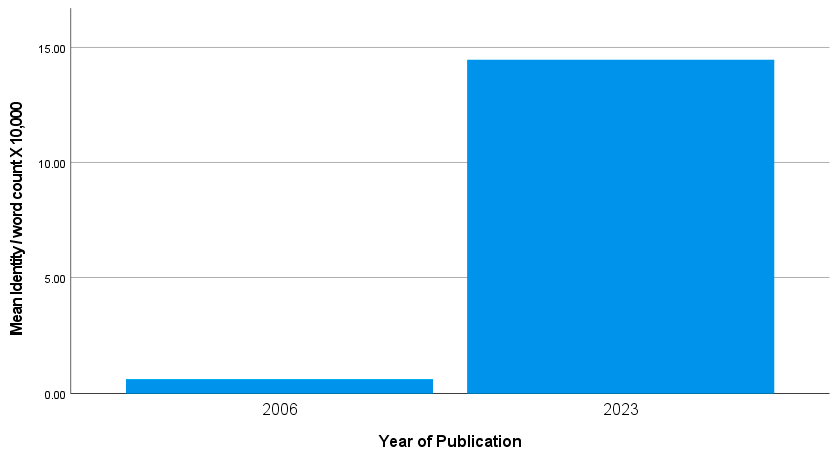
The amount of Critical Theory language as a percentage x 103 of total words148 in the new 2023 Language Curriculum has increased by 355.24% from the previous 2006 Language Curriculum, as shown in Table 1 and Figure 1. Parsing this further, there has been a 243.35% increase in the use of the terms equity, diversity, and inclusion together, and a 57.80% increase in use of the term Critical Literacy. With respect to identitarian concerns, the term identity, used in its Critical Theory sense, has shown a whopping 2,233.87% increase from the previous Language Curriculum to the new one intended to respond to the Report (see Table 2 and Figure 2).

Table 1.
Increase in Critical Theory language
| Year | Percentage × 103 of Critical Theory Terms per total words |
|---|---|
| 2006 | 14.79 |
| 2023 | 67.33 |
| Percentage Increase in Critical Theory Language | 355.24% Increase |
Figure 1.
Comparison of amount of Critical Theory language: 2006 vs. 2023 Language Curriculum
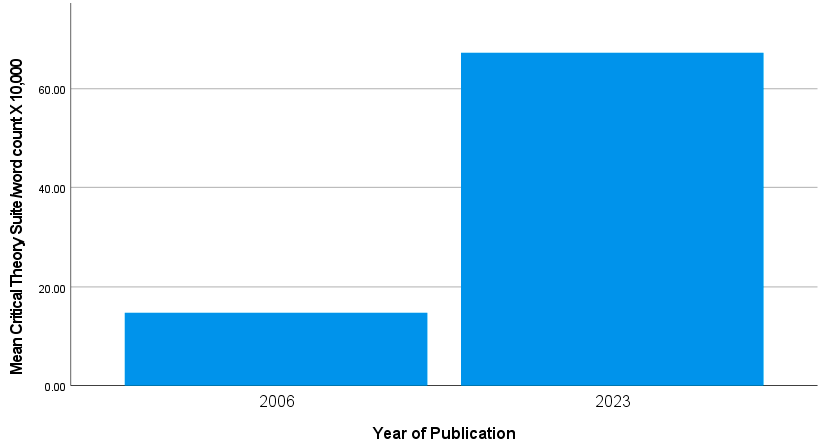
Table 2.
Increase in Reference to Identity
| Year | Percentage × 103 of Term Identity |
|---|---|
| 2006 | 0.62 |
| 2023 | 14.47 |
| Percentage Increase in Reference to Identity | 2,233.87% Increase |
Figure 2.
Comparison of the use of the term identity: 2006 vs. 2023 Language Curriculum.
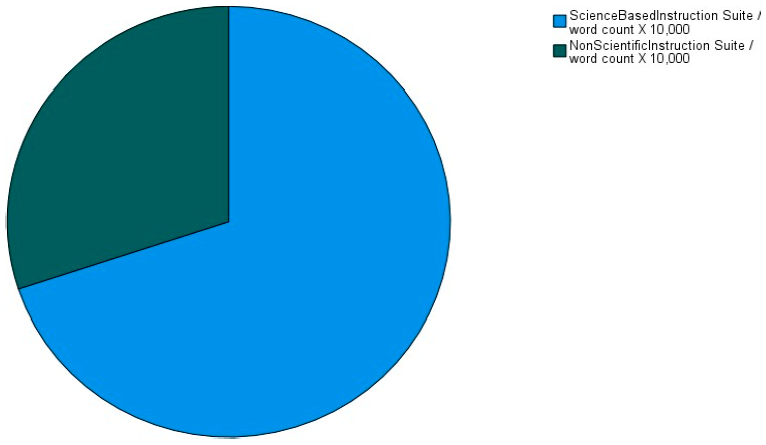
Investigating cognitive science-based versus non-cognitive science-based terminology in both curricula, there is indeed an improvement from the old to the new, with the ratio of the former (1.07/1) to the latter (2.32/1) evidencing a 229.85% growth in cognitive science-based language in the 2023 Curriculum relative to growth in non-cognitive science-based language. In 2006, both types of terminology were used about equally. In 2023, there is more than double the cognitive science-based language than terminology that is not reading science-based. This indicates that the Ministry has indeed taken at least some heed of the Report’s advice, as reflected in Table 3 and Figure 3 and Figure 4, below.
Table 3.
Growth in cognitive science-based language relative to growth in non-cognitive science-based language
Table 3.
Growth in cognitive science-based language relative to growth in non-cognitive science-based language
| Year | Cognitive Science-Based | Non-Cognitive Science-Based | Ratio of Cognitive Science-Based to Non-Cognitive Science-Based | Percent Difference Between Cognitive Science-Based to Non-Cognitive Science-Based Language |
|---|---|---|---|---|
| 2006 | 14.32 | 13.39 | 1.07/1 | 6.95% MORE Cognitive Science- Based Language |
| 2023 | 63.60 | 27.36 | 2.32/1 | 132.46% MORE Cognitive Science-Based Language |
| Percent Increase/ Decrease | 344.13% Increase | 104.33% Increase | N/A | 229.85% Growth in Cognitive Science-Based Language Relative to Growth in Non-Cognitive Science-Based Language. |
Figure 3.
Comparison of science-based vs. non-science-based curriculum and pedagogy in Language Curriculum (2006 vs. 2023) following OHRC Right to Read Report
Figure 3.
Comparison of science-based vs. non-science-based curriculum and pedagogy in Language Curriculum (2006 vs. 2023) following OHRC Right to Read Report
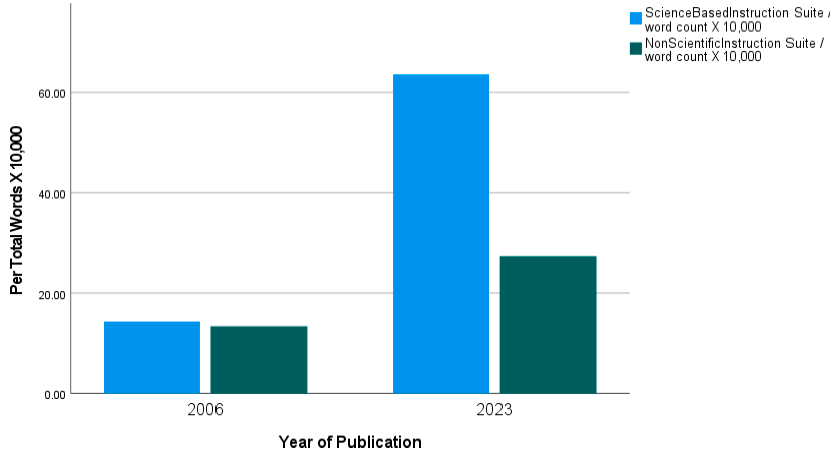
Figure 4.
Comparison of content in 2023 Language Curriculum: Learning science vs. non-learning science-based terminology.
Figure 4.
Comparison of content in 2023 Language Curriculum: Learning science vs. non-learning science-based terminology.
Comparing terminology reflecting a Critical Theory-focus versus a cognitive or Learning Science-focus in both old and new Language curricula reveals that in 2006, there was a nearly equal focus on both Critical Theory and Learning Science. There is slightly more Critical Theory terminology in the new 2023 curriculum (5.86% more) than Learning Science terminology, indicating a 3.22% increase in Critical Theory language relative to any changes in Learning Science-based language from 2006 to 2023 (see Table 4 and Figure 5 and Figure 6, below).
Table 4.
Growth in Critical Theory language relative to change in cognitive science-based language
| Year | CT-Based Language | Cognitive Science-Based Language re Curriculum and Pedagogy | Ratio of CT-Based Language to Cognitive Science-Based Language | Percent Difference Between CT and Cognitive Science- Based Language |
|---|---|---|---|---|
| 2006 | 14.79 | 14.32 | 1.03/1 | 3.28% MORE Critical Theory Language |
| 2023 | 67.33 | 63.60 | 1.05/1 | 5.86% MORE Critical Theory Language |
| Percent Increase/ Decrease | 355.24% | 344.13% Increase | N/A | 3.22% Growth in Critical Theory Language Relative to Change in Cognitive Science-Based Language |
Figure 5.
Comparison of Critical Theory vs. Learning Science language in 2006 and 2023 Language Curricula
Figure 5.
Comparison of Critical Theory vs. Learning Science language in 2006 and 2023 Language Curricula
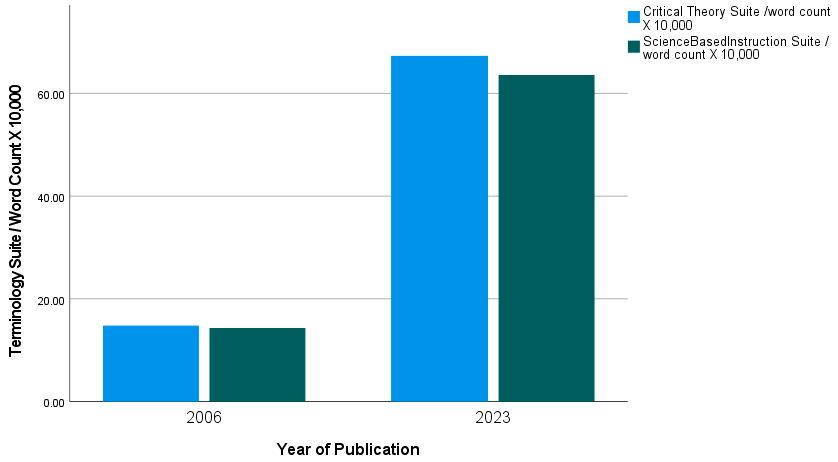
Figure 6.
Comparison of content in 2023 Language Curriculum: Critical Theory vs. Learning Science-Based terminology
Figure 6.
Comparison of content in 2023 Language Curriculum: Critical Theory vs. Learning Science-Based terminology
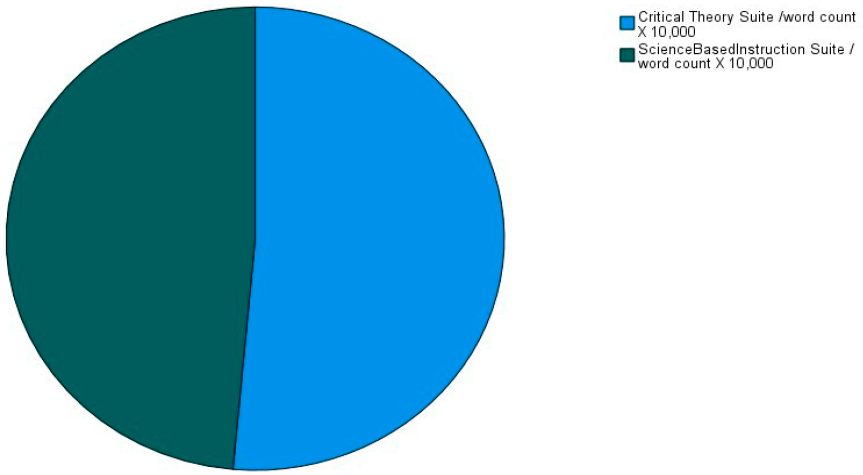
Figure 5 and Figure 6 clearly demonstrate, however, that the amount of Learning (cognitive) Science terminology and Critical Theory terminology is nearly equal, thus evidencing a disregard for the Right to Read Report’s recommendation that socio-cultural issues should be de-emphasized in favour of prioritizing Learning Science-based approaches to language instruction.
Discussion
As for the limitations of this study, the quantitative findings are predicated on the model of terminology trends149; however, the limited focus on just two documents precludes any statistical analysis. Nevertheless, the descriptive picture is clear enough, along with my qualitative findings, to conclude that the hypothesis to my first research question was correct: the Ministry has not in fact completely overhauled the Language Curriculum by supplanting Critical Theory and its constituent constructivist and identitarian elements with cognitive or Learning Science-based mandates.
It is clear that there have been some changes in the new Curriculum in favour of Learning Science, but not a clear and wholesale shift in focus, as required by the OHRC. The Curriculum now contains an explanation of the importance of systematic phonics instruction, and a basic framework for it now exists where none did before, albeit only in an appendix to the 2023 Curriculum. Use of Learning Science-based language in the new Curriculum is now double that of terminology not supported by cognitive science. All of this is commendable. Unfortunately, the framework provided is confusingly organized; it does not employ a specific program such as the synthetic phonics program used with great success in Scotland,150 and is likely insufficient for teachers who have never been taught how to construct a systematic phonics program proven effective by the research.
In addition, it is noteworthy that there has been no revision to the Kindergarten Program, requiring a kindergarten teacher to consult with the K-8 curriculum if the Report’s recommendations are to be fulfilled. The new curriculum also fails to provide a standardized or centralized assessment, and consequently, no way to measure any effects on a go-forward basis. As previously discussed, the EQAO as currently administered, is not sufficiently reliable to provide feedback on whether the new curriculum will make a difference. Further, the EQAO is not an assessment for learning which can inform the tiered approach in the classroom. No teaching materials are provided by the Ministry for classroom use, and no thought was put into revising the Trillium list so that it was ready for use at the same time as the new curriculum.
Unfortunately, the Curriculum contains inconsistent messaging to teachers about whether direct instruction of a systematic phonics program is mandatory or merely suggested. Curriculum directions to the effect that learning styles or student background are factors in how reading should be taught do not align with cognitive science principles, nor with the Right to Read Report’s recommendations. The apparent inability of the curriculum drafters in the Ministry’s bureaucracy to let go of sacredly held, but empirically misguided ideas such as differentiated and cross-curricular instruction, student interest, and learning needs and styles, reveals itself in the incongruent messaging of the new Curriculum. The fact is that the learning needs of children are the same for all: children need to become fluent readers by the end of Grade 1; and learning styles are a myth, disproven long ago.151
Moreover, importing the four strands by four strands curricular structure from previous curricula, when the Ministry had a perfect opportunity to overhaul the Curriculum to make it actionable, is a missed opportunity and a serious misstep. Even a person who spends hours trying to make sense out of the two sets of four strands – and the numerous sub-strands – is unlikely to come away with any practical sense of how to translate this mess into lessons with clear goals grounded in reality instead of eduspeak. It simply makes no sense that in Grade 1, students are supposed to learn to match a grapheme with the sound it makes, while at the same time applying this in “cross-curricular and integrated learning”, making “connections to diverse voices, experiences, perspectives, histories, and contributions, including those of First Nations, Métis, and Inuit individuals, communities, groups, and nations”, while, among other things, using digital tools to design and “develop creative solutions to authentic, real-world problems”.152 Clearly, it is impossible for a child in Grade 1 to be able to accomplish whatever any of this means, and I question the ability of the average Ontario teacher to fulfil such learning expectations in the course of a school year. It should be axiomatic that if something is inactionable – as the 2023 Language Curriculum is – it has no place in an elementary school. To be clear, Ontario’s current design for all curricula needs a re-think. Using the 2023 Language Curriculum as an example, it is too long, too verbose, too analytically complex and impenetrable, and wrongly focused on student expectations rather than on what teachers are supposed to teach. It is teachers who read the curriculum, not students. As such, the Language Curriculum would be far more effective as a user-friendly manual for teachers, which centres their needs, what they should be doing, and with what program and materials.
The new Curriculum also distracts from what and how teachers need to teach by the continued infusion of Critical Theory principles which have nothing to do with elementary school teaching and Learning Science,153 Teachers trained in universities are already de-emphasizing actual domain subject matter knowledge for Critical Theory concerns,154 such as racial and gender identity, power and privilege, cultural assets, co-construction, and ill-defined notions of other knowledges in the service of the even more poorly defined decolonization project.155
Cultivating a navel-gazing identity along the axes of race, ethnicity, gender, and sexuality156 that is politically useful in overthrowing capitalism,157 instead of exposing children to the world outside of themselves through knowledge they do not possess158 is already a priority of Ontario’s educational system.159 This continues apace in the new Language Curriculum as evidenced by the 2,233.87% increase in use of the term identity. A real shift in reading and writing pedagogy demands a firm pivot in curricular focus to the science of reading, and sadly, this simply has not happened. Even while newly touting the benefits of direct instruction, the curriculum continues to press for CRRP, politically useful identity formation, and for the student-centred inquiry, discovery, and project-based methods Critical Theory requires. The ratio of Critical Theory to Learning Science-based terminology in the 2006 and 2023 Language curricula has barely moved. Either students learn reading by a strict commitment to whole classroom, tier 1, direct instruction of a systematic phonics program, or they learn to read in many different ways based on identity, but they cannot do both. Unfortunately, isomorphism (i.e., the copying of American socio-cultural priorities) and agenda-setting appears to have gotten in the way of clarity of purpose.
Interestingly, the OHRC itself appears to have succumbed to Critical Theory hegemony in parts of its Report, contradicting its own concern that socio-cultural matters consume greater interest and energy of educators than the findings from cognitive science research. While insisting that Indigenous students learn to read exactly the same as all other students, the Report makes 26 recommendations with respect to Indigenous students, almost all of which have nothing to do with changing the current misguided notions of instruction aligned with identity. Only one of the Report’s recommendations about teaching Indigenous children to read relates to the clear science-based solution, and even then, the OHRC appears unable to focus solely on the science, stating that foundational reading skills ought to “incorporate Indigenous experiences, culture and values throughout classroom content”,160 without spelling out what any of those things are and how they relate to sounding out the letter B. Similarly, the Report also falls into the hegemonic grasp of Critical Theory in adding one incoherent note that CRRP must be included in reading instruction (which contradicts its recommendation to shift focus away from socio-cultural concerns), while at the same time admitting that the subject of culturally responsive teaching is outside the scope of its inquiry. It is difficult to reconcile this one note with the overall thrust of the Report in pouring cold water on the notion that student interest, or one’s lived experience, results in better reading outcomes. Anglo-American rationalization and agenda-setting theories provide the only explanation for the Right to Read Report’s occasional off-message waffling.
My hypothesis as to there being little difference in the Critical Theory, constructivist, and identitarian focus of both the 2006 Curriculum published by a Liberal government and the Conservatives’ 2023 Curriculum, despite the latter having the additive of direct instruction of systematic phonics, proved to be incorrect, but not in the way I expected. There has been a 355.24% increase in Critical Theory language from 2006 to the 2023, that is, from a Liberal to a Conservative government-produced policy document. This is a much larger increase than my previous research findings dealing with all curricula and teacher resources, where I found that Doug Ford’s government used 83% more Critical Theory language in publications aimed at students in the K-12 classroom (to the year 2022) as compared to previous Liberal governments.161 While seemingly inexplicable given a Conservative government pushing a back-to-basics agenda,162 the explanation lies in the adoption of American framing, isomorphism, and agenda-setting by the bureaucracy tasked with curriculum drafting.163 The results from this research provide further evidence of Davies and Guppy’s argument that the ideological stance of the bureaucracy has little connection to the ideological stance of the government in power.
In conclusion, Ontario’s new Language Curriculum is unlikely to address the OHRC’s concerns, and is unlikely to presage a wholesale shift to curricula and pedagogy backed by Learning Science findings. While Critical Theory concepts belong in a university theory class, they have no place in a Grade 1 classroom where the school’s primary job is to teach all children to read fluently. Those concerned about actual fairness, and ensuring that all children – no matter their family circumstances – receive the best and most effective reading and writing instruction, have reason to worry. The Ministry’s beauticians busily applying lipstick to a metaphoric pig164 may believe that the public will be satisfied with cosmetic changes that mimic, but do not fulfil the demands of Learning Science, but eventually, uneven, lacklustre, or even negligible progress will make the pretence clear: Ministry bureaucrats have failed to transform the mess of the Language Curriculum into a serviceable vehicle for ensuring a literacy rate scraping the 100% mark. It is hoped that this article will serve as a wake-up call to faculties of education, Ministry bureaucrats, the government, teachers, and parents, so as to force the Ministry to enact curricular reforms that address young children’s right to read, instead of indulging the luxury – and armchair revolutionary – beliefs of elite neo-Marxist ideologues in the academy and within the bureaucracy itself.
Funding
This research received no external funding.
Acknowledgments
The author would like to acknowledge the support and encouragement of his MA and PhD supervisor, Dr. Scott Davies, without whom, he would not have been able to translate his suspicions into actionable evidence. The author also would like to acknowledge and thank Dr. Jim Hewitt of the University of Toronto for his wisdom and guidance on the Science of Learning, and the Heterodox Academy for its support and advocacy for a more open-minded and viewpoint-diverse academia.
Conflicts of Interest
The author declares no conflict of interest.
| 1 | Ministry of Education (hereafter Ministry), 1993. |
| 2 | Reich, 2024. |
| 3 | Ministry, 1993. |
| 4 | Ministry, 2009; 2015. |
| 5 | Ministry, 2017. |
| 6 | Ministry, 2010; Ministry, 2011. |
| 7 | Ministry, 2013; Ministry, 2018. |
| 8 | Reich, 2024. |
| 9 | Ladson-Billings, 1995; Gay, 2002. |
| 10 | Becker & Gersten, 1982. |
| 11 | Willingham, 2009; Hirsch, 2018. |
| 12 | Reich, 2024. |
| 13 | Ontario Human Rights Commission. 2022. |
| 14 | This is not a peer-reviewed paper in a journal, but an article produced in the magazine of the Elementary Teachers’ Federation of Ontario: Kim & Zwolinsky, 2023. |
| 15 | Ministry, 2023a. |
| 16 | Ministry, 2023b. |
| 17 | Government of Ontario, 2023. |
| 18 | Dancy-Scott et al., 2018. |
| 19 | Ministry, 2006. |
| 20 | Bishop, 2014. |
| 21 | Ladson-Billings, 1995; Gay, 2002. |
| 22 | McLaughlin, 1999; Kolakowski, 1978. |
| 23 | McLaren, 1998; Agger, 1991; Blake & Masschelein, 2003. |
| 24 | Tate, 1997; Russell & Cameron, 2016. |
| 25 | Rowlands & Carson, 2002; Gutiérrez, 2017. |
| 26 | Kolakowski, 1978; Bohman, 2005. |
| 27 | Tate, 1997. |
| 28 | Bohman, 2005. |
| 29 | Agger, 1991; Blake & Masschelein, 2003; Bohman, 2005. |
| 30 | Kolakowski, 1978; Blake & Masschelein, 2003. |
| 31 | Kolakowski, 1978. |
| 32 | Marcuse, 1965. |
| 33 | Dei, 1995; Hung et al., 2007; Meekosha & Shuttleworth 2009); Butler, 2020. |
| 34 | Weiler, 1996; Lopez, 2015. |
| 35 | Gay, 2002. |
| 36 | Willingham et al., 2015. |
| 37 | Harper, 1997; Tate, 1997; Lopez, 2015. |
| 38 | Ertmer & Newby, 1993. |
| 39 | Darling & Nordenbo, 2003. Progressivism. |
| 40 | Bilgrami, 2006. |
| 41 | Ministry, 1993; 2006; 2009; 2017. |
| 42 | Jorg et al., 2007. |
| 43 | Bohman, 2005. |
| 44 | Weiler, 1996. |
| 45 | Gay, 2002. |
| 46 | Ladson-Billings,1995. |
| 47 | Ladson-Billings, 1995; Gay, 2002. |
| 48 | Labaree, 2004. |
| 49 | Gay, 2002. |
| 50 | Gay, 2002. |
| 51 | Akena, 2012; D’Abrera, 2023. |
| 52 | Lopez, 2015. |
| 53 | Tate, 1997; Prewitt, 2016. |
| 54 | Dei, 1995; Tate, 1997; Matias & Mackey, 2016. |
| 55 | Aronson & Laughter, 2016.. |
| 56 | Byrd, 2006; Caballero, 2010. |
| 57 | Statistics Canada, 2022. |
| 58 | Aronson & Laughter, 2016. |
| 59 | Byrd, 2006. |
| 60 | Becker & Gersten, 1982; Willingham, 2009; Hirsch, 2018. |
| 61 | Sweller, 1988; Rosenshine, 2012. |
| 62 | Kirschner et al., 2006; Rosenshine, 2012. |
| 63 | Hirsch, 2018. |
| 64 | Sweller, 1988. |
| 65 | Kirschner et al., 2006. |
| 66 | Willingham, 2009; Hirsch, 2018. |
| 67 | Paas et al., 2004. |
| 68 | Sweller,1988; Paas et al., 2004; Jorg et al., 2007; Andersen & Andersen, 2017. |
| 69 | Willingham, 2015; Christodoulou, 2014; Capp, 2017. |
| 70 | Sweller,1988,; Willingham, 2009; Rosenshine, 2012. |
| 71 | Geary, 2008. |
| 72 | Dei,1995; Tate,1997; Russell & Cameron, 2016. |
| 73 | This is a news opinion-piece, not a peer-reviewed journal article: Carroll, 2022. |
| 74 | OHRC, 2022. |
| 75 | Hattie, 2008. |
| 76 | Carpenter et al., 2020. |
| 77 | Hartman et al., 2023. |
| 78 | OHRC, 2022: 185, 205, 206, 217. |
| 79 | Sinclair, 2005. |
| 80 | Oliver et al., 2021. |
| 81 | Ladson-Billings, 1995; Blake & Masschelein, 2003. |
| 82 | Dei, 1995. |
| 83 | Shah et al., 2022. |
| 84 | Jorg et al., 2007. |
| 85 | OHRC, 2022. |
| 86 | Ministry, 1993. |
| 87 | For example, see Ministry, 2009; 2015. |
| 88 | Ministry, 1993. |
| 89 | Dei, 1995; Tate, 1997; Matias & Mackey, 2016. |
| 90 | Ministry, 1993; Ladson-Billings, 1995; Hargreaves et al., 2018. |
| 91 | See OHRC, 2022: 141–142. |
| 92 | Geary, 2008. |
| 93 | Geary, 2008. |
| 94 | OHRC, 2022. |
| 95 | Ministry, 2003. |
| 96 | Also see Willingham et al., 2015. |
| 97 | Johnston & Watson, 2005. |
| 98 | This is not a peer reviewed article, but rather a synthesis of the author’s peer-reviewed research, published in Psychology Today: Gentry, 2023. |
| 99 | Gentry, 2023. |
| 100 | The OTF report is a position paper and not a peer-reviewed article in a journal: Ontario Teachers’ Federation, 2022; Kim & Zwolinsky, 2023. |
| 101 | Davies & Guppy, 1997. |
| 102 | Canada, the United States, Australia, the United Kingdom, and New Zealand, as defined by Davies & Guppy, 1997. |
| 103 | Davies & Guppy, 1997. |
| 104 | McLaren, 1998; Agger, 1991; Blake & Masschelein, 2003. |
| 105 | Pells, 2004. |
| 106 | Harper, 1997; Davies & Guppy, 1997. |
| 107 | Davies & Guppy, 1997. |
| 108 | Davies & Guppy, 1997. |
| 109 | Cobb & Elder, 1971. |
| 110 | Cook et al., 1983. |
| 111 | Mehta, 2013. |
| 112 | Sweller, 1988; Willingham, 2009; Hirsch, 2018. |
| 113 | Cobb & Elder, 1971. |
| 114 | See Ministry, 1993; 2009; 2017. |
| 115 | Shackel, 2005. |
| 116 | Prewitt, 2016; Hirschman, 2004. |
| 117 | Ministry, 1993; 2009; 2017; Shah et al., 2022. |
| 118 | This is a news article from US newspaper The Washington Post, reporting on its survey, and not an academic paper: Fisher, 2013. |
| 119 | Baekgaard et al., 2018. |
| 120 | Schelsky, 1974. |
| 121 | Davies & Guppy, 1997. |
| 122 | Rozado, 2022. |
| 123 | Reich, 2024. |
| 124 | Ministry, 2023b. |
| 125 | Ministry, 2023c. |
| 126 | Sweller, 1988; Ertmer & Newby, 1993; Willingham, 2009; Hirsch, 2018. |
| 127 | Rozado, 2022; Reich, 2024. |
| 128 | Ministry, 2006, 2023a,b. |
| 129 | Ministry, 2023c. |
| 130 | For example, link to this article. |
| 131 | See link to this article. |
| 132 | See link to this article. |
| 133 | For example, link to this article. |
| 134 | Willingham, 2009. |
| 135 | Ministry, 2023a: 67. |
| 136 | OHRC, 2022: 34. |
| 137 | Ministry, 2023a: 9. |
| 138 | OHRC, 2022: 141–142. |
| 139 | Ministry, 2023a: pp. 11, 20. |
| 140 | Willingham, 2009; Willingham et al., 2015. |
| 141 | Ministry, 2023a: 11. |
| 142 | Ministry, 2023a: 77, 79. |
| 143 | Ministry, 2023a: 77, 79. |
| 144 | Ministry, 2023a: 100–111. |
| 145 | Ministry, 2023a: 98–100. |
| 146 | Willingham, 2009. |
| 147 | Ministry, 2023a: 112–114. |
| 148 | Multiplying the percentage by 10,000 (103) was done for visual ease and to eliminate long strings of decimals. |
| 149 | Rozado, 2020; 2022. |
| 150 | Johnston & Watson, 2005. |
| 151 | Willingham et al., 2015. |
| 152 | Ministry, 2023a: 98–100. |
| 153 | Jorg et al., 2007. |
| 154 | Harper, 1997; Hargreaves et al., 2018; Ministry, 2013; 2017; Davies, 1999; 2002. |
| 155 | Shah et al., 2022; Donald, 2022; Rodway et al., 2023. |
| 156 | Hargreaves et al., 2018. |
| 157 | Lopez, 2015; Blake & Masschelein, 2003; Russell & Cameron, 2016; Matias & Mackey, 2016. |
| 158 | Hirsch, 2018. |
| 159 | Reich, 2024. |
| 160 | OHRC, 2022: 147. |
| 161 | Reich, 2024. |
| 162 | This is not a peer-reviewed journal, but a news report from CBC: Crawley, 2023. Ontario’s ‘back to basics’ push in education: Here’s what you need to know. CBC New. |
| 163 | Schelsky, 1974; Davies & Guppy, 1997; Pells, 2004; Mehta, 2013. |
| 164 | Definition: To make some superficial or cosmetic change to something so that it seems more attractive, appealing, or successful than it really is. See: Putting lipstick on a pig, n.d; Zimmer, 2008. |
References
- Agger, B. Critical theory, poststructuralism, postmodernism: Their sociological relevance. Annual Review of Sociology 1991, 17(1), 105–131. [Google Scholar] [CrossRef]
- Akena, F. Critical analysis of the production of western knowledge and its implications for Indigenous knowledge and decolonization. Journal of Black Studies 2012, 43(6), 599–619. [Google Scholar] [CrossRef]
- Andersen, I. G.; Andersen, S.C. Student-centered instruction and academic achievement: Linking mechanisms of educational inequality to schools’ instructional strategy. British Journal of Sociology of Education 2017, 38(4), 533–550. [Google Scholar] [CrossRef]
- Aronson, B.; Laughter, J. The theory and practice of culturally relevant education: A synthesis of research across content areas. Review of Educational Research 2016, 86(1), 163–206. [Google Scholar] [CrossRef]
- Baekgaard, M.; Mortensen, P. B.; Bech Seeberg, H. The bureaucracy and the policy agenda. Journal of Public Administration Research and Theory 2018, 28(2), 239–253. [Google Scholar] [CrossRef]
- Becker, W.C.; Gersten, R. A follow-up of follow through: The later effects of the direct instruction model on children in fifth and sixth grades. American Educational Research Journal 1982, 19(1), 75–92. [Google Scholar] [CrossRef]
- Bilgrami, A. Notes toward the definition of “identity”. Daedalus 2006, 135(4), 5–14. [Google Scholar] [CrossRef]
- Bishop, E. Critical literacy–Bringing theory to praxis. Journal of Curriculum Theorizing 2014, 30(1), 51–63. [Google Scholar]
- Blake, N.; Masschelein, J. CT and critical pedagogy. The Blackwell Guide to the Philosophy of Education 2003, 2, 38–56. [Google Scholar]
- Bohman, J. CT. The Stanford Encyclopedia of Philosophy. (Spring 2021). Zalta, E.N., Ed.; 2005. link to this article accessed February 2, 2023.
- BusinessTech South Africa Staff Writer. The most racist countries in the world. BusinessTech. 2016. link to this article accessed April 25, 2023.
- Butler, J. Performative acts and gender constitution: An essay in phenomenology and feminist theory. In Feminist Theory Reader; Routledge, 2020; pp. 353–361. [Google Scholar]
- Byrd, C.M. Does culturally relevant teaching work? An examination from student perspectives. SAGE Open, July–September 2016 2006, 1–10. [Google Scholar] [CrossRef]
- Caballero, J.A. The effects of the teacher-student relationship, teacher expectancy, and culturally-relevant pedagogy on student academic achievement. Doctoral dissertation, University of Redlands, Redlands, CA, USA, 2010. [Google Scholar]
- Capp, M. J. The effectiveness of universal design for learning: A meta-analysis of literature between 2013 and 2016. International Journal of Inclusive Education 2017, 21(8), 791–807. [Google Scholar] [CrossRef]
- Carpenter, S.; Witherby, A.; Tauber, S. On students’ (mis)judgments of learning and teaching effectiveness. Journal of Applied Research in Memory and Cognition 2020, 9. [Google Scholar] [CrossRef]
- Carroll, L. ‘We changed everything’: How 56 schools transformed their teaching and boosted results. The Sydney Morning Herald. 2022. link to this article accessed April 25, 2023.
- Christodoulou, D. Seven Myths About Education; Routledge: New York, 2014. [Google Scholar]
- Cobb, R.W.; Elder, C.D. The politics of agenda-building: An alternative perspective for modern democratic theory. The Journal of Politics 1971, 33(4), 892–915. [Google Scholar] [CrossRef]
- Cook, F.L.; Tyler, T.R.; Goetz, E.G.; Gordon, M.T.; Protess, D.; Leff, D.R.; Molotch, H.L. Media and agenda setting: Effects on the public, interest group leaders, policy makers, and policy. Public Opinion Quarterly 1983, 47(1), 16–35. [Google Scholar] [CrossRef]
- Crawley, M. Ontario’s ‘back to basics’ push in education: Here’s what you need to know. CBC News. 2023. link to this article accessed October 12, 2023.
- D’Abrera, B. Who teaches the teachers? An audit of teaching degrees at Australian universities. Institute of Public Affairs. 2023. link to this article accessed February 14, 2024.
- Dancy-Scott, N.; Dutcher, G.A.; Keselman, A.; Hochstein, C.; Copty, C.; Ben-Senia, D.; Rajan, S.; Asencio, M.G.; Choi, J.J. Trends in HIV terminology: Text mining and data visualization assessment of international AIDS conference abstracts over 25 years. JMIR Public Health and Surveillance 2018, 4(2), e50. [Google Scholar]
- Darling, J.; Nordenbo, S.E. Progressivism. In The Blackwell Guide to the Philosophy of Education; 2003; Chapter 16; pp. 288–308. [Google Scholar]
- Davies, S. From moral duty to cultural rights: A case study of political framing in education. Sociology of Education 1999, 72, 1–21. [Google Scholar] [CrossRef]
- Davies, S. The paradox of progressive education: A frame analysis. Sociology of Education 2002, 75(4), 269–286. [Google Scholar] [CrossRef]
- Davies, S.; Guppy, N. Globalization and educational reforms in Anglo-American democracies. Comparative Education Review 1997, 41, 435–459. [Google Scholar] [CrossRef]
- Dei, G.J.S. Integrative anti-racism: Intersection of race, class, and gender. Race, Gender & Class 1995, 2(3), 11–30. [Google Scholar]
- Donald, D. A curriculum for educating differently – unlearning colonialism and renewing kinship relations. EdCanNetwork. 2022. link to this article accessed February 1, 2023.
- Ertmer, P.; Newby, T.J. Behaviorism, cognitivism, constructivism: Comparing critical features from an instructional design perspective. Performance Improvement Quarterly 1993, 6(4). [Google Scholar] [CrossRef]
- Fisher, M. A fascinating map of the world’s most and least racially tolerant countries. The Washington Post. 2013. link to this article accessed April 25, 2023.
- Gay, G. Preparing for culturally responsive teaching. Journal of Teacher Education 2002, 53(2), 106–116. [Google Scholar] [CrossRef]
- Geary, D. C. An evolutionarily informed education science. Educational Psychologist 2008, 43(1), 179–195. [Google Scholar]
- Gentry, J.R. Elite universities call for change in reading education. Psychology Today. 2023. link to this article accessed October 4, 2023.
- Government of Ontario. News Release: Ontario launches plan to boost math, writing and reading skills. Newsroom. 2023. link to this article accessed October 5, 2023.
- Gutiérrez, R. Living mathematx: Towards a vision for the future. Philosophy of Mathematics Education 2017, 32(1). [Google Scholar]
- Hargreaves, A.; Shirley, D.; Wagnia, S.; Bacon, C.; D’Angelo, M. Leading from the Middle: Spreading Learning, Well-being, and Identity Across Ontario. Council of Ontario Directors of Education. 2018. link to this article accessed February 14, 2023.
- Harper, H. Difference and diversity in Ontario schooling. Canadian Journal of Education 1997, 22(2), 192. [Google Scholar]
- Hartman, J.A.R.; Hart, S.; Nelson, E.A.; Kirschner, P.A. Designing mathematics standards in agreement with science. International Electronic Journal of Mathematics Education 2023, 18(3), em0739. link to this article accessed April 24, 2023. [Google Scholar]
- Hattie, J. Visible Learning: A Synthesis of Over 800 Meta-Analyses Relating to Achievement; Routledge: London, 2008. [Google Scholar]
- Hirsch, E.D., Jr. Why Knowledge Matters. Rescuing Our Children rom Failed Educational Theories, 3rd ed.; Harvard Educational Press: Cambridge, MA, 2018. [Google Scholar]
- Hirschman, C. The origins and demise of the concept of race. Population and Development Review 2004, 30(3), 385–415. [Google Scholar]
- Hung, D.; Bopry, J.; Looi, C.-K.; Kohthe, T.S. Situated cognition and beyond: Martin Heidegger on transformations in being and identity. In Praeger Handbook of Education and Psychology, Vol. 4; Kincheloe, J.L., Horn, R.A., Eds.; Greenwood Publishing Group, 2007; Chapter 83. [Google Scholar]
- Johnston, R.S.; Watson, J.E. A Seven Year Study of the Effects of Synthetic Phonics Teaching on Reading and Spelling Attainment; Scottish Executive Education Department, Information, Analysis and Communication Division: Livingstone, Scotland, 2005. [Google Scholar]
- Jorg, T.; Davisc, B.; Nickmans, G. Towards a new, complexity science of learning and education. Educational Research Review 2007, 2, 145–156. [Google Scholar]
- Kim, K.; Zwolinsky, T. Navigating the complex implications of the Right to Read inquiry report. ETFO Voice, Summer 2023 Ed. 2023. link to this article accessed October 4, 2023.
- Kirschner, P.A.; Sweller, J.; Clark, R.E. Why minimal guidance during instruction does not work: An analysis of the failure of constructivist, discovery, problem-based, experiential, and inquiry-based teaching. Educational Psychologist 2006, 41(2), 75–86. [Google Scholar]
- Kolakowski, L. Main Currents of Marxism, Volume 3 – The Breakdown; Oxford University Press: New York, 1978. [Google Scholar]
- Labaree, D. The ed school’s romance with progressivism. Brookings Papers on Education Policy, 2004. [Google Scholar]
- Ladson-Billings, G. Toward a theory of culturally relevant pedagogy. American Educational Research Journal 1995, 32(3), 465–491. [Google Scholar]
- Lopez, A.E. Navigating cultural borders in diverse contexts: Building capacity through culturally responsive leadership and critical praxis. Multicultural Education Review 2015, 7(3), 171–184. [Google Scholar]
- Marcuse, H. PRepressive tolerance. Reproduced in Political Elites in a Democracy; Routledge: London, 1965; pp. 138–169. [Google Scholar]
- Matias, C.E.; Mackey, J. Breakin’ down whiteness in antiracist teaching: Introducing critical whiteness pedagogy. The Urban Review 2016, 48, 32–50. [Google Scholar]
- McLaren, P. Revolutionary pedagogy in post-revolutionary times: Rethinking the political economy of critical education. Educational Theory 1998, 48(4). [Google Scholar]
- McLaughlin, N. Origin myths in the social sciences: Fromm, the Frankfurt School and the emergence of CT. The Canadian Journal of Sociology 1999, 24(1), 109–139. [Google Scholar]
- Meekosha, H.; Shuttleworth, R. What’s so “critical” about critical disability studies? Australian Journal of Human Rights 2009, 15(1), 47–75. [Google Scholar]
- Mehta, J. The Allure of Order. High Hopes, Dashed Expectations, and the Troubled Quest to Remake American Schooling; Oxford University Press: Oxford, 2013. [Google Scholar]
- Ministry of Education. Antiracism and Ethnocultural Equity in School Boards. Guidelines for Policy Development and Implementation; The Queen’s Printer: Toronto, 1993. [Google Scholar]
- Ministry of Education. A Guide to Effective Instruction in Reading. In Kindergarten to Grade 3; Queen’s Printer: Toronto, 2003. [Google Scholar]
- Ministry of Education. The Ontario Curriculum–Language. Grades 1–8; The Queen’s Printer: Toronto, 2006. [Google Scholar]
- Ministry of Education. Ontario’s Equity and Inclusive Education Strategy; The Queen’s Printer: Toronto, 2009. [Google Scholar]
- Ministry of Education. Caring and Safe Schools in Ontario; The Queen’s Printer: Toronto, 2010. [Google Scholar]
- Ministry of Education. Student identity and engagement in elementary schools. In Capacity Building Series; The Queen’s Printer: Toronto, 2011. [Google Scholar]
- Ministry of Education. Supporting Minds–An Educator’s Guide to Promoting Students’ Mental Health and Wellbeing; The Queen’s Printer: Toronto, 2013. [Google Scholar]
- Ministry of Education. Pedagogical documentation revisited. In Capacity Building Series, K-12; The Queen’s Printer: Toronto, 2015. [Google Scholar]
- Ministry of Education. Ontario’s Education Equity Plan; The Queen’s Printer: Toronto, 2017. [Google Scholar]
- Ministry of Education. The Ontario Curriculum Gr 9-10-Canadian and World Studies-Geography, History, Civics; The Queen’s Printer: Toronto, 2018. [Google Scholar]
- Ministry of Education. The Ontario Curriculum–Language. Grades 1–8; The King’s Printer: Toronto, 2023a. [Google Scholar]
- Ministry of Education. Effective Early Reading Instruction: A Guide for Teachers. 2023b. link to this article accessed September 12, 2023.
- Ministry of Education. Ontario Trillium List of Approved Textbooks as of January 2023. 2023c. link to this article accessed September 25, 2023.
- Oliver, M.; McConney, A.; Woods-McConney, A. The efficacy of inquiry-based instruction in science: a Comparative analysis of six countries using PISA 2015. Research in Science Education 2021, 51(2), S595–S616. [Google Scholar] [CrossRef]
- Ontario Human Rights Commission. Right to Read. In quiry Report; The Queen’s Printer: Toronto, 2022. [Google Scholar]
- Ontario Teachers’ Federation. OTF Position on the Right to Read Report of the Ontario Human Rights Commission (OHRC). 2022. link to this article accessed October 4, 2023.
- Paas, F.; Renkl, A.; Sweller, J. Cognitive load theory: Instructional implications of the interaction between information structures and cognitive architecture. Instructional Science 2004, 32(1–2), 1–8. [Google Scholar]
- Pells, R. From modernism to the movies: The globalization of American culture in the twentieth century. European Journal of American Culture 2004, 23(2), 143–155. [Google Scholar]
- Prewitt, K. What Is “Your” Race?: The Census and Our Flawed Efforts to Classify Americans; Princeton University Press, 2016. [Google Scholar]
- Putting lipstick on a pig. Farlex Dictionary of Idioms (2015). n.d. link to this article accessed October 12, 2023.
- Reich, S. Does Ontario’s Ministry of Education Promote CT in K-12 Education? Master’s thesis, University of Toronto, Ontario, Canada, 2024. [Google Scholar]
- Rodway, J.; Campbell, C.; Lopez, A.; Moore, S.; Ng-A-Fook, N.; Schnellert, L. Decolonizing professional learning–gathering together for educational change. EdCanNetwork. 2023. link to this article accessed February1, 2023.
- Rosenshine, B. Principles of instruction. Research-based strategies that all teachers should know. American Educator 2012, 36(1), 12–19. [Google Scholar]
- Rowlands, S.; Carson, R. Where would formal, academic mathematics stand in a curriculum informed by ethnomathematics? A critical review of ethnomathematics. Educational Studies in Mathematics 2002, 50, 79–102. [Google Scholar]
- Rozado, D. Prejudice and victimization themes in New York Times “discourse”: A chronological analysis. Academic Questions 2020, 33(1), 89–100. [Google Scholar]
- Rozado, D. Themes in academic literature: Prejudice and social justice. Academic Questions 2022, 35(2), 16–29. [Google Scholar]
- Russell, C.; Cameron, E. Conclusion: A fat pedagogy manifesto. Counterpoints 2016, 467, 251–256. [Google Scholar]
- Schelsky, H. The new strategy of revolution: The “long march” through the institutions. Modern Age 1974, 18(4), 345–355. [Google Scholar]
- Shackel, N. The vacuity of postmodernist methodology. Metaphilosophy 2005, 36(3), 295–320. [Google Scholar]
- Shah, V.; Cuglievan-Mindreau, G.; Flessa, J. Reforming for racial justice: A narrative synthesis and critique of the literature on district reform in Ontario over 25 years. Canadian Journal of Educational Administration and Policy 2022, 198, 35–54. [Google Scholar]
- Sinclair, J.P. The effects of explicit instruction on the structure of urban minority children’s academic writing. Dissertation Abstracts International Section A: Humanities and Social Sciences 2005, 66(3-A), 896. [Google Scholar]
- Statistics Canada. Visible Minority by Ethnic or Cultural Origin by Gender and Age. Table 98-10-0355-01. 2022. link to this article accessed January 30, 2023.
- Sweller, J. Cognitive load during problem solving: Effects on learning. Cognitive Science 1988, 12, 257–285. [Google Scholar]
- Tate, W.F., IV. Critical race theory and education: History, theory, and implications. Review of Research in Education 1997, 22, 195–247. [Google Scholar]
- Weiler, K. Myths of Paulo Freire. Educational Theory 1996, 46(3), 353–371. [Google Scholar] [CrossRef]
- Willingham, D.; Hughes, E.; Dobolyi, D. The scientific status of learning styles theories. Teaching of Psychology 2015, 42(3), 266–271. [Google Scholar]
- Willingham, D.T. Why Don’t Students Like School? A Cognitive Scientist Answers Questions about How the Mind Works and What It Means for the Classroom; Wiley: San Francisco, 2009. [Google Scholar]
- Zimmer, B. Who first put “lipstick on a pig”? The origins of the porcine proverb. Slate. 2008. link to this article accessed October 12, 2023.
© 2025 Copyright by the author. This article is an open access article distributed under the terms and conditions of the Creative Commons Attribution (CC BY) license (https://creativecommons.org/licenses/by/4.0/).
