
Controversial_Ideas , 6(1), 1; doi:10.63466/jci06010001
Article
The Equality Paradox
Author email: S.Tezuka@protonmail.com
How to Cite: Tezuka, S. The Equality Paradox. Controversial Ideas 2026, 6(1), 1; doi:10.63466/jci06010001.
Received: 16 November 2025 / Accepted: 17 March 2026 / Published: 10 May 2026
Abstract
:Group differences in average cognitive ability are often considered the most controversial topic in psychology, and various attempts have been made to suppress research in this area. Supporters of these measures have justified them on the grounds that such research is socially harmful. However, in recent years the assumption that all demographic groups have equal average ability has been a major cause of racial discrimination in the United States. This discrimination has most frequently been directed against high-achieving groups, on the grounds that they have not legitimately earned their success. Separately, within the American criminal justice system the same assumption has resulted in racial discrimination with respect to which defendants receive the death penalty. In order to uphold a non-discriminatory society consistent with the principles of liberalism, research about group differences should not be suppressed, and should instead be used responsibly to oppose these forms of prejudice.
Keywords:
intelligence; cognitive ability; race; discrimination; equity; liberalism; IQ commensurability; research ethics1. Introduction
For many years, academics have had instincts about what topics in psychology are subject to the strongest taboos, but only recently has an attempt been made to determine the answer empirically. In a study published in 2024, a team of researchers surveyed 470 psychology faculty at 133 American universities, asking them their views on 10 taboo conclusions that had been nominated by their peers. Although this was not the only metric examined, the hypothesis that those surveyed were most inclined to discourage other academics from studying was the following: “Genetic differences explain non-trivial (10% or more) variance in race differences in intelligence test scores” (Clark et al., 2025). This hypothesis also had one of the strongest correlations between self-censorship and belief in the hypothesis’s veracity, with those who believed it to be correct being the most afraid to express their views about it.
This paper will not take a position on whether the hypothesis is correct or incorrect, but will argue that such a taboo is socially harmful, and that it has worsened the problem of racial discrimination in American society.
1.1. Background of the Controversy
The hypothesis that group differences in average IQ include a non-trivial genetic component is commonly known as hereditarianism or Jensenism, after Arthur Jensen, the educational psychologist who first presented it in its modern form. Hereditarianism proposes that the genetic variants that affect human cognitive ability vary in their distribution among global populations, and that this variation is contributing to the measured difference in average IQ scores among racial groups.
It is extremely unlikely that variation in cognitive ability (or any other human trait) aligns precisely with racial divisions, because what we know as human races are a set of culturally based divisions that have been imposed on the continuum of human genetic variation. According to anthropologist John Relethford (2009), race is “a culturally constructed label that crudely and imprecisely describes real variation.” Because racial categories are primarily cultural rather than biological entities, hypotheses to explain group differences in average test scores usually do not invoke race itself as a cause. Instead, these hypotheses propose that the differences are caused by one or more of the many variables that correlate with racial divisions, potentially including genetic variation as well as cultural and economic factors. Earl B. Hunt (2011) explains:
Race and ethnicity are seldom causal variables in themselves. The only exceptions are in studies of the reactions of others to a person of a given race, and studies of the effects of self-identity on people’s conceptions of themselves. In these situations the application of a label may itself be a stimulus that leads to action. Outside of such situations, a researcher who studies a correlation between racial/ethnic status and a test score is studying the correlation between the score and the many possibly causal variables correlated with race and ethnicity. These include educational status, biological distinctions, health and wealth, and a variety of beliefs and behavioral practices.(Hunt, 2011, pp. 409–10)
Although contemporary scholarship about race and genetics usually argues against the utility of racial categories, a consistently replicated finding is that SIRE (self-identified race/ethnicity) is strongly correlated with genetic measures of ancestry, especially in the United States (Tang et al., 2005; Yuan et al., 2018; Fang et al., 2019). Nagar et al. (2020) conclude that “Continental ancestry predicts individuals’ SIRE with > 96% accuracy,” while also noting that this result is “very much consistent with a number of previous studies of the US population.” Due to this correlation between racial categories and biogeographic ancestry, a trait that varies between global populations may also vary between racial groups, even when the nature of the underlying variation is not truly “racial.” A well-known example of such a trait is cystic fibrosis, which varies in a complex manner between regions of the world, but whose global distribution makes it overall more common in people who identify as “white” than in other racial groups (Mirtajani et al., 2017).
Unlike cystic fibrosis, human cognitive ability is a polygenic trait, influenced by a vast number of genetic variants, each with a tiny effect (Plomin & Von Stumm, 2018; Deary et al., 2022; Haier et al., 2024, pp. 176–88). However, global variation also has been found to exist in the distribution of polygenic traits, including physiological traits such as height,1 body mass index, coronary artery disease, and type II diabetes, as well as psychological or behavioral traits such as schizophrenia, Alzheimer’s Disease, and educational attainment (the tendency to complete more years of education) (Guo et al., 2018; Racimo et al., 2018). When natural selection acts on a polygenic trait, by causing small shifts in the frequencies of the many genetic variants that affect it, it is known as a “soft sweep”, while “hard sweep” refers to selective sweeps that have major effects on the frequency of an individual genetic variant (Stern & Nielsen, 2019). Soft sweeps have been the dominant source of adaptive change in humanity’s recent evolutionary history, with Schrider and Kern (2017) finding they account for 92.2% of selective sweeps across all populations.
Several studies have concluded that in European populations, cognitive ability is among the many traits that have been subject to positive selection recently in human evolutionary history (Kuijpers et al., 2022; Jandarova & Rustichini, 2023; Akbari et al., 2024).2 There is not yet enough data to perform this type of analysis about most other human populations. While the question of what causes group differences in average IQ scores is most often investigated within the field of intelligence research, studies like these show how the same question also can be approached from the direction of evolutionary genetics. The question is: did the recent positive selection for human cognitive ability vary between regions of the world, as occurred for many other polygenic traits, or was the selection for this trait uniform everywhere?
Theoretically, empirical research could be done in support of either a partially genetic or purely environmental cause of group differences, but proponents of the two views have very different attitudes towards such research. Here the term “empirical research” refers to studies that collect new data or perform new statistical analyses, rather than commentaries on or critiques of studies done by others. Connor and Fuerst (2024) compile ten recent empirical studies investigating the causes of the differences, along with three commentary articles, all by supporters of hereditarianism. In contrast, while some prominent opponents of hereditarianism such as Eric Turkheimer have published empirical research about other aspects of human cognitive ability, they typically regard such research about group differences with contempt. Turkheimer (2024) explains his attitude regarding this area of study:
The reader hoping for a detailed review of this miserable literature is going to be disappointed because I’m not going to do it. In my opinion, the whole business—studies of black children adopted into white families, statistical manipulations of parameters from factor analyses, follow-ups of children fathered by black American soldiers and white European mothers, or the more recent genomic estimates of the percentage of European ancestry among African Americans—is one big unproductive waste of time.(Turkheimer, 2024, p. 143)
In lieu of empirical research, contemporary opposition to hereditarianism has relied primarily on efforts to prevent research about group differences from taking place. What these efforts have entailed is covered in the next section.
1.2. Forbidden Fruit
The most basic form of opposition to research about group differences has been directed against efforts to publish papers about the topic. Carl and Woodley (2024) describe a recent case in which a paper about group differences was rejected from a journal on the grounds that it “may lead to or enhance political controversies”, with the managing editor explaining that this was not “an evaluation of the quality of your work (which would require a scientific review process).” On a separate occasion described by the same authors, one such paper was rejected on the grounds that “it addresses a politically sensitive issue that [the editor] would prefer not to appear.” Some authors have openly advocated preventing the publication of such research. This argument was made in a “consensus report” by Michelle Meyer et al. (2023) published in Hastings Center Report:
We all recommend that, absent the relevant compelling justification(s)—a criterion that some of us think will never be met—researchers not conduct, funders not fund, and journals not publish research on sensitive phenotypes that compares groups defined by race, ethnicity, or genetic ancestry, where genetic ancestry could easily be misunderstood as race or ethnicity.
A subsequent Hastings Center Report paper by Aaron Panofsky et al. (2024) has argued that access to genetic data should be restricted, in order to prevent its being used for research about race or other inappropriate topics. A well-known example of such a policy has blocked access to the Database of Genotypes and Phenotypes for research about genetics and intelligence, including research that does not relate to race or ethnicity, despite this being a government-run database that is paid for by U.S. taxpayers (Lee, 2022). Panofsky et al. argue:
Second, considering that data availability and reuse have been among the community features that have made human genetics vulnerable to counterscience, restricting access might be part of the strategy for closing the evidentiary culture. Data repositories and consortia are beginning to take these actions. Some scientists have argued that restriction is a totalitarian affront to scientific freedom, but restriction need not be direct prohibition. It could involve increasing friction.
In March 2024, the American Association of Biological Anthropologists held a symposium titled “Undermining the production of race science.” The symposium’s stated goal was to “form the basis for a comprehensive and in-depth guide that will aid scholars of human evolution in writing effective reviews to make it more difficult for race science to get into the literature and to improve our own scholarship when it comes to issues at the intersection of race and biology” (Roseman, 2024a). Kevin Bird, one of the symposium’s participants, argued in a paper published in American Psychologist that race research is socially harmful because of “its use by racial extremists, sometimes directly assisted by psychologists, to influence social policies regarding immigration, social welfare, criminal justice, and diversity and to preserve the racialized structure of society” (Bird et al., 2024).
Another goal of the AABA symposium was “Developing concrete changes to mainstream evolutionary theory and method that make it more difficult for race scientists to use mainstream scholarship in their work” (Roseman, 2024b). Several of the symposium’s presentations made specific proposals about how evolutionary biology should be modified to prevent race research from making use of its findings, described as “reforming our own sciences so that we no longer give it support” (Roseman, 2024a) or “how we can shift methodological norms towards ones that do not as easily play into the premise of race science” (Athreya et al., 2024). The rejection of otherwise mainstream ideas in biology, due entirely to their potential to support race research, is an example of what Shuichi Tezuka (2021) describes as a “domino effect” that tends to occur when a hypothesis is rejected on religious or political grounds. Or as Tezuka (2022) put it: moral judgments about science cannot remain confined to a single idea for long.
Yet another form that opposition to race research has taken is professional sanctions against those who publish about the topic, with Ceci and Williams (2009) providing a summary of the practice. The resulting deterrent might be the single most important process sustaining this topic’s taboo. In the same book quoted previously, Eric Turkheimer explains his support for this method:
Many of the people who argue that they have been persecuted because of their racist ideas were untenured: denied a new hire or a renewed contract in an untenured line. In a world in which tenure, by design, can leave us stuck with bad scholarship, the Academe has to protect itself on the front end. If someone with a research program involving half-baked genetic explanations of alleged racial differences in intelligence applies for a tenure-track job in my department, I will vote No and sleep soundly.(Turkheimer, 2024, p. 147)
This proposed exception to academic freedom has been applied to a wider range of academics than those who support hereditarianism. In 2022, John Sherman, a professor of chemistry at the University of British Columbia, was placed on indefinite leave for stating that racial groups have unequal performance on IQ tests (Bawaan, 2022). The context of Sherman’s comment was a discussion about the meaning of the word “racist”, with Sherman arguing that it should not be considered racist to discuss possible interpretations of these test results. In the comments for which he was suspended, Sherman (2022) explicitly took no position about the causes or implications of group differences in average test scores; his comments were merely asserting that these differences exist.
Other methods of research prevention described here—including restrictions on access to genetic data, and the suggested restrictions on what research can be funded or published—similarly apply to race research or intelligence research in general, rather than only to hereditarianism. In one of the more extreme cases, the National Institutes of Health’s restrictions on access to its datasets, prohibiting their usage in research that they consider “sensitive” or “stigmatizing,” have blocked access to this data for research about Alzheimer’s Disease (Candeub, 2024). The NIH has prohibited its data being used for this research because Alzheimer’s Disease is often detected using tests of cognitive ability, so Alzheimer’s research theoretically falls within the category of research about genetics and intelligence (Ritchie, 2022). While Clark et al. (2025) describe this situation as a taboo on the hypothesis that group differences include a non-trivial genetic component, the taboo’s boundaries are not clearly defined. It has routinely applied to studying or discussing these differences at all, or to various other topics and ideas that are perceived as having some connection to the hypothesis.3
The fear that research about group differences might be misused by those with harmful intentions is not groundless. After the publication of Arthur Jensen’s 1969 monograph that initiated the modern debate over race and IQ, Jensen received letters from segregationist groups seeking his support, despite his objections that he opposed racial segregation (Miele, 2002, p. 21). More recently, research about group differences in average cognitive ability has been promoted by White nationalists and other far-right individuals (Bird et al., 2023). A book by Steven Pinker (2025) raises a similar concern:
If differences in average intelligence are commonly known, especially if they are seen to be genetic and hard to eliminate, people might be tempted to use them as Bayesian priors in their treatment of individual African Americans, unjustly putting them at a disadvantage. It might embolden racists, make it easy to overlook systemic racism, shake the confidence of individual African Americans, and further divide the country along racial lines.(Pinker, 2025, p. 278)
Pinker (2025, p. 276) explains that “Since the argument for academic freedom rests on the value of considering opposing ideas,” his purpose in the quoted passage is to “present the best case I can think of for limiting intellectual expression.” In other words, the argument that this area of study should be off-limits is not necessarily Pinker’s personal view. Pinker (2025, p. 279) also mentions a critically important caveat: “it may be too late. Our era is obsessed with racial differences, attributing them unquestioningly to racism, which only invites curious people to wonder whether they might be attributed to other causes, intensifying the regime that criminalizes such curiosity.”
This caveat connects to the central reason that such efforts at suppression have caused harm. The assumption that all groups have equal average ability, and that all racial disparities are caused by racism, has led to widespread racial discrimination in recent years, with this paper focusing on the assumption’s effects in the United States. For those who share the fundamental liberal value that all individuals deserve equal rights, regardless of their racial identity, there is a moral obligation to ensure that attempts to undermine this value do not succeed.
2. Equality vs. Equity
We hold these truths to be self-evident, that all men are created equal, that they are endowed by their Creator with certain unalienable Rights, that among these are Life, Liberty and the pursuit of Happiness.
Thus wrote Thomas Jefferson in the Declaration of Independence. This statement is among the founding principles of the United States, but there are competing interpretations as to what it means.
One interpretation is that all human beings are equally entitled to rights such as freedom of speech, freedom of religion, the right to own property, and the right to receive a fair trial when charged with a crime. It follows that the duty of governments is to protect these rights of all individuals, without showing favoritism based on race, class, gender, or religion. From this perspective, the statement “all men are created equal” is silent about whether humans are equal in their abilities or tendencies, because a person’s rights do not depend on their personality or skills.
Historically, this is the meaning that Jefferson intended, as his other writings indicate that he did not believe individuals or groups to have identical abilities. In a letter to John Adams, Jefferson wrote that there exists “a natural aristocracy among men”, and that “The grounds of this are virtue and talents” (Coffman, 2012, p. 261). In his 1785 book Notes on the State of Virginia, Jefferson also expressed the opinion that the distribution of intellectual abilities varies among racial groups (Jefferson, [1785] 1832, pp. 144–51). A century before the first IQ tests, this was a highly speculative conclusion, and Jefferson’s views on race and intelligence were expressed using crude terms such as “superior” and “inferior” that were typical of his time. However, in a letter to Henri Grégoire, Jefferson emphasized that his views on race differences by no means diminished his belief that all are deserving of equal rights: “whatever be their degree of talent it is no measure of their rights. Because Sir Isaac Newton was superior to others in understanding, he was not therefore lord of the person or property of others” (Ford, 1898, pp. 246–47).
The other possible interpretation of the statement “all men are created equal” is that all human beings—or demographic groups of human beings—possess equal abilities and tendencies in socially valued traits, and therefore all are deserving of approximately equal life outcomes. In modern times, the term equality usually refers to members of all groups being entitled to equal treatment, while equity refers to all groups of people having roughly equal outcomes. The concept of equity is famously explained by Ibram X. Kendi in his influential book How to Be an Antiracist:
Racial inequity is when two or more racial groups are not standing on approximately equal footing. Here’s an example of racial inequity: 71 percent of White families lived in owner-occupied homes in 2014, compared to 45 percent of Latinx families and 41 percent of Black families. Racial equity is when two or more racial groups are standing on a relatively equal footing. An example of racial equity would be if there were relatively equitable percentages of all three racial groups living in owner-occupied homes in the forties, seventies, or, better, nineties.(Kendi, 2019a, p. 18)
A central assumption of Kendi’s perspective is that racial inequities have only one possible cause. He explains, “Antiracist ideas argue that racist policies are the cause of racial inequities” (Kendi, 2019a, p. 20). In an article published as part of a Politico symposium, Kendi (2019b) argued that the United States should amend its Constitution with a statement of these two principles of the drive for equity: “Racial inequity is evidence of racist policy and the different racial groups are equals.” In this context, the term “equal” is not being used in Jeffersonian sense—deserving of equal rights—because Kendi has made it clear that achieving equity will require discriminating based on race: “The only remedy to racist discrimination is antiracist discrimination. The only remedy to past discrimination is present discrimination. The only remedy to present discrimination is future discrimination” (Kendi, 2019a, p. 19).
If all demographic groups of humans deserve approximately equal average outcomes, and therefore “antiracist discrimination” is necessary to achieve racial equity, this cannot coexist with Jefferson’s original premise that everyone deserves equal treatment under the law. Kendi’s book acknowledges that these two goals are incompatible, describing “the construct of race neutrality” as the greatest enemy to achieving racial equity (Kendi, 2019a, p. 20). Although this might seem an extreme conclusion, it is difficult to avoid if one accepts the premise that all racial disparities are directly or indirectly caused by racism. If Kendi’s premise is correct, it would mean that racism is shaping the demographics of every area of American society where racial disparities exist, and such a situation could reasonably be regarded as a moral emergency. Accepting this premise also would mean that, theoretically, it should be possible to reform society in a way that makes all racial disparities disappear.
This is what I call the racial equality paradox: if one is committed to giving equal treatment to all individuals regardless of race, it is necessary to reject Kendi’s view that all racial disparities are caused by racism (and do not reflect any difference in the underlying distribution of preferences or abilities), as well as the resulting goal of equality of outcomes. This does not mean abandoning the goal of eliminating racial prejudice where it exists, nor does it mean giving up on reducing the size of disparities when that can be accomplished without engaging in racial discrimination. However, it means accepting that eliminating racial disparities altogether is not a realistic goal, at least not without some as-yet-undiscovered intervention unlike anything that has been attempted up to this point. It also means understanding that in cases where these disparities continue to exist even after visible forms of discrimination have been eradicated, their continued existence does not justify blaming or discriminating against any group of people.
Although the term “equality paradox” with respect to race is coined in this paper, a related concept called the “gender equality paradox” is already well known. The latter term refers to the widely observed phenomenon that gender differences in career choices tend to be more pronounced in countries with a greater degree of social and political equality between the genders, with fewer women tending to choose STEM jobs in the societies where women have the most freedom (West et al., 2019). The focus here will be on the equality paradox with respect to race, but the broader principle also should be noted: with respect to both race and gender, there is a tradeoff between equality of outcomes and equality of rights.
3. Life, Liberty, and the Pursuit of Equity
Kendi’s worldview was one of the guiding principles of the Biden administration. Vice President Kamala Harris (2022) explained her understanding of this principle at an event for the Oakland Generation Fund, a program of financial assistance for children of low-income families. “So equity, as a concept, says: Recognize that everyone has the same capacity, but in order for them to have equal opportunity to reach that capacity, we must pay attention to this issue of equity if we are to expect and allow people to compete on equal footing.” In his remarks about signing an infrastructure bill into law, President Joe Biden (2022) put it more succinctly: “Talent is equally distributed, but opportunity is not.” On the basis of this worldview, Biden (2021) issued an executive order to advance “an ambitious whole-of-government equity agenda.”
The ways that this executive order shaped the Biden administration’s policies were most evident in their COVID relief initiative known as the “American Rescue Plan”, which prioritized funding by both race and gender. This program provided financial relief to farmers only if they belonged to “socially disadvantaged” groups. This category was defined as farmers who were African American, Native American or Alaskan native, Hispanic, Asian American or Pacific Islander, while White farmers were not eligible for the benefits (Gerstmann, 2021b). A federal judge eventually halted this program on the grounds that it constituted illegal racial discrimination, explaining that “Plaintiffs are excluded from the program based on their race and are thus experiencing discrimination at the hands of their government” (Griesbach, 2021).
Another program established by the American Rescue Plan, known as the Restaurant Revitalization Fund, prioritized benefits to minority-owned restaurants (Gerstmann, 2021a). According to this fund’s criteria, only certain specific national origins conferred “minority” status—for example, individuals with ancestry from Pakistan and India qualified for the special treatment, while those with ancestry from Afghanistan, Iran, and Iraq did not. Like the racially exclusive benefits to farmers, the racial component of this program was halted by a federal judge, who commented that “The stark realities of the Small Business Administration’s racial gerrymandering are inescapable” (Norris, 2021). Following these court rulings, the Biden administration implemented programs of racial preferences in two further pieces of legislation: the Infrastructure Investment and Jobs Act and the CHIPS act, both of which prioritized grants for minority-owned businesses (Chandler et al., 2024). Among the provisions of these bills was to expand the scope and funding of the Minority Business Development Agency, which went on to be the subject of a lawsuit alleging that it was engaging in illegal racial discrimination (Mark, 2023). As in the other cases, the court eventually found this agency’s system of racial preferences to be unconstitutional (United States Congress, 2024).
The policies for which this agency was sued were part of a larger constellation of racial preferences, mostly at the state level, that exist in benefits for businesses. Most U.S. states have adopted programs whereby businesses may obtain various special benefits by becoming certified as MBE (minority business enterprise) or MWBE (minority and women-owned business enterprise) (Butkovich, 2021), including some programs that predate the Biden presidency. The precise requirements for a company to obtain this certification vary by state, but a typical requirement from the state of California is for a company to be “at least 51% owned by one or more minority individuals, and whose management and daily operations are controlled by one or more of those individuals” (California Public Utilities Commission, 2025). Among the benefits that California provides for MBEs is a statutory goal to award these businesses “15% of all contracts awarded by any state agency, department, officer, or other state governmental entity” (Arambula, 2007). Unlike the federal racial policies implemented under Biden, these state-level policies are still commonplace. California’s MBE program is active as of 2025, and in June 2025, the state government of New York extended its own MWBE program through 2028 (Hancock Estabrook, 2025).
Below the federal and state level, programs of racial discrimination in the name of equity also have been adopted in local governments. It is impossible to list every such policy, but keeping the spotlight on California, a typical example is a pair of racially exclusive financial stimulus programs adopted in 2021 by Marin County and Oakland. To be eligible for the cash benefits under the Oakland program, a person was required to have at least one child under 18, be earning no more than 50% of the area’s median income, and be BIPOC (Black, Indigenous, and/or people of color) (Batchelor, 2021). The Marin County program provided cash grants to low-income women who were raising at least one child, but only if they were “women of color” (Cabanatuan, 2021). The Marin County program was run by a non-profit organization called the Marin Community Foundation, with financial support from the Marin County Board of Supervisors, while the Oakland program was run by the county government itself (Britschgi, 2021). The Marin County and Oakland programs ended in 2024 and 2025 respectively, not due to any legal challenge, but because they were intended as experimental and the experiment had run its course (Halstead, 2024; Ravani, 2025).4
This discussion has been mainly limited to discrimination in the name of equity by the U.S. public sector, as similar cases in the private sector are too numerous to provide a complete overview.5 A brief selection of public sector examples from other U.S. states includes a state-run homebuying program in Washington state that excluded applicants based on their race; state guidelines for treating COVID-19 in New York that prioritized treatments by race (Friedersdorf, 2024); statewide racial preferences in Vermont’s COVID-19 vaccination program (Galewitz, 2021); and a pandemic relief grant program run by the state of Oregon that was offered only to residents who identify as Black (Eligon, 2021). A separate but related outcome, previously covered in JCI by Abbot et al. (2023), is the rejection of merit-based standards by scientific journals and institutions, on the assumption that racial disparities in STEM fields demonstrate that merit-based standards perpetuate systemic racism. Fields discussed by Abbot et al. that have been impacted by this change include medicine, psychology, physics, chemistry, and global health.
The Universal Declaration of Human Rights, an international document adopted by the United Nations (United Nations General Assembly, 1949), states that “All are equal before the law”, and that “Everyone has the right of equal access to public service in his country.” This document is among the cornerstones of modern liberalism, and is reflected in human rights laws and national constitutions around the world (Tomuschat, 2017). In the United States, racial discrimination in employment, public accommodations, and federally funded programs also has been prohibited for over sixty years by the Civil Rights Act of 1964 (National Archives, 2022). Similar principles are enshrined in several state constitutions, including a provision in the state constitution of California that forbids both the state and any city or county within it from providing preferential treatment based on “race, sex, color, ethnicity, or national origin in the operation of public employment, public education, or public contracting” (California State Legislature, 2019). Marin County and Oakland’s programs of race-based benefits were adopted less than six months after California’s voters had rejected a proposal to repeal this provision of their state constitution (Friedersdorf, 2020).6 By abandoning what had previously seemed a well-established moral and legal principle, the Biden administration, as well as American state and local governments, have exhibited a fundamental shift with respect to the role of governments in a society.
The rejection of this tenet of liberalism, and the belief that governments must provide preferential treatment based on race, was an inevitable endpoint of discourse about racial disparities in the United States. As programs such as the No Child Left Behind Act have not succeeded at eliminating the disparities, proposals for overt racial preferences have grown in popularity because they are presumed to be the only remaining solution (Howard & Navarro, 2016). The assumption is that as large racial disparities have persisted despite heroic efforts to eliminate them, simple explanations based on factors such as the quality of public schools have gradually become less plausible, and the disparities must instead be a product of subtle forms of racism. Although racial bias in the United States undoubtedly still exists, these arguments take it for granted that racist social systems are the cause of ongoing racial disparities, without attempting to empirically establish a causal connection.
Aside from Kendi’s How to be an Antiracist, probably the most influential contemporary antiracist book is Robin DiAngelo’s White Fragility. Like Kendi, DiAngelo (2018, pp. 22–23) makes this assumption: “Many whites see racism as a thing of the past, and of course, we are well served not to acknowledge it in the present. Yet racial disparity between whites and people of color continues to exist in every institution across society, and in many cases is increasing rather than decreasing.” A third major antiracist text, which presents itself as an overview of the critical race theory (CRT) perspective, is the fourth edition of the textbook Critical Race Theory: An Introduction by Richard Delgado and Jean Stefancic. Delgado and Stefancic (2023, pp. 11–13) argue that despite the disappearance of overt manifestations of racism such as lynching, the racist nature of American society is demonstrated by the continued existence of racial disparities in education, socio-economic status, occupational status, incarceration, and health outcomes. In a section titled “Critique of liberalism”, Delgado and Stefancic’s book goes on to argue:
[I]f racism is embedded in our thought processes and social structures as deeply as many crits [critical race theorists] believe, then the “ordinary business” of society—the routines, practices, and institutions that we rely on to do the world’s work—will keep minorities in subordinate positions. Only aggressive, color-conscious efforts to change the way things are will do much to ameliorate misery.(Delgado & Stefancic, 2023, pp. 27–28)
These developments are the ironic background against which research about group differences in average ability is accused of supporting the racialized structure of society. As the area of study has been accused of causing this social harm, U.S. federal, state, and local governments were simultaneously adopting the “aggressive, color-conscious efforts” advocated by antiracist authors and publications, justified on the belief that racial disparities cannot have any other explanation besides racism. That research about group differences becoming taboo would increase the importance American society places on racial categories, instead of diminishing it, also was not entirely unpredictable. Over a decade before these extreme measures became commonplace, in a book chapter about social consequences of group differences, University of Delaware psychologist Linda Gottfredson warned that results such as these were the cost of assuming that all racial disparities in life outcomes must instead reflect the presence or absence of social privilege. (Gottfredson’s summary uses the term “inequality” for what is nowadays called “inequity”, because it was written before the term “inequity” became the accepted term for racial disparities.) Gottfredson wrote:
Perhaps the biggest consequence of adhering to social privilege theory is that it has progressively radicalized the definition of discrimination. According to social privilege theory, there would be no racial inequality in a fair, non-discriminatory society. The continuing existence of racial inequality is therefore proof of continuing discrimination. The fact that racial inequality permeates nearly all aspects of American life means, then, that racial discrimination permeates nearly all aspects of American life. The fact that overtly discriminatory acts are rarely observed today means only that discrimination has become hidden from view. That seemingly sincere, well-meaning whites deny being bigoted means only that their bigotry is unconscious and they refuse to admit it. That black students perform less well on average than their white classmates means that their teachers must be racist, and the latter seem to prove their guilt if they suggest that their black students sometimes have more difficulty learning the curriculum. The fact that some racial-ethnic groups disproportionately fail to meet objective race-neutral standards is proof of further insidious racism, namely, that these standards were established with the intent to favor the dominant class while appearing to do otherwise. According to social privilege theory, high-achieving groups (at least European whites) are therefore automatically guilty of profiting from an oppressive social system, and low-achieving groups are being robbed of what is rightfully theirs. Every inequality becomes more evidence of entrenched evil. The talk of brotherhood 50 years ago is replaced by talk of reparations and retribution; the hope of mutual respect among the races by mutual resentment.
At the time when the book containing this quote was published, Gottfredson’s summary was an extremely pessimistic description of American society, because in 2006 concepts such as White privilege, White fragility, and the field of Whiteness studies had not yet entered the intellectual mainstream. Her summary is best understood not as a literal description of race relations in the early 2000s, but as a warning about the eventual results that would occur if society refused to discuss group differences and their social consequences. In general, the ability to make accurate predictions is regarded as a key characteristic of a successful theory or research program (Lakatos, 1974; Kane, 2016). While most predictions made by research about group differences have been centered on genetic or psychometric data, Gottfredson’s was an example of such a prediction with a broader scope, albeit one whose eventual fulfillment was very unfortunate.
4. Race and Gluckschmerz
The majority of public discussion about racial equity has focused on groups that are under-represented in socially valued roles relative to their share of the population. But the knife cuts both ways: if racial inequities are a sign of injustice and require racial preferences to address them, then that is also true when minority groups are over-represented in socially valued roles. Despite its high-minded justification, in practice this type of discrimination has often resembled White resentment directed at more successful groups. It has especially affected people of East Asian and Ashkenazi Jewish descent, two groups whose average IQ scores are higher than the average score of people of non-Ashkenazi European descent (Winegard et al., 2020).
4.1. American Universities
One well-known recent example of discrimination against a successful group has been directed against Asian American university applicants. An analysis by economist Mark Perry (2017) found that in applications to medical schools, a student with a MCAT score of 24–26 and a GPA of 3.2–3.39 would have a 56% chance of being accepted if they were Black, a 31% chance of being admitted if they were Hispanic, an 8% chance of being admitted if they were White, and only a 6% chance of being admitted if they were Asian American. A book by Heather Mac Donald (2023, pp. 31–54) describes this discrimination by medical schools as resulting from a refusal to acknowledge the existence of an “academic skills gap” between racial groups. It consequently is assumed that racial disparities in academic qualifications must be the result of racism, and that racial preferences are necessary as a corrective measure.
These programs of discrimination against Asian Americans received public attention in the context of the Supreme Court case Students for Fair Admissions v. Harvard, which examined them in admissions to Harvard University. An analysis by Arcidiacono et al. (2022), published in European Economic Review while the Supreme Court case was underway, found that when qualifications were equal, a Harvard applicant being Asian American conferred a 19% penalty in their chance of admission relative to if they were White. Like Heather Mac Donald’s book, this analysis notes that Asian American applicants have, on average, stronger academic credentials than White applicants. The Supreme Court ultimately concluded that Harvard was engaging in racial discrimination against Asian Americans, and found these and similar racial preferences by universities to be unlawful.
Instead of openly discriminating based on race, Harvard depressed Asian Americans’ odds of admission by scoring them lower than other groups on subjective measures of traits such as “positive personality,” likability, courage, and kindness (Hartocollis, 2018). UC Berkely law professor Prasad Krishnamurthy (2022) gave this summary of the data from Harvard applications: “Harvard either discriminates against Asian applicants or, consistent with a pernicious stereotype, Asian applicants have substantially worse personalities than those of any other racial group.” That is, when Harvard refused to acknowledge the existence of higher average academic ability among Asian Americans, this led to them promoting a far more harmful (and entirely unsupported) stereotype about the group.
Although the Students for Fair Admissions v. Harvard ruling found racial preferences in university admissions to be illegal, American universities have continued to apply racial preferences with respect to hiring faculty, despite racial discrimination in employment being prohibited by the Civil Rights Act of 1964. Universities’ programs of discrimination in hiring have included offering employment only to a select group of candidates, who are chosen using a process designed to ensure that the candidate pool has the correct racial composition (Sailer, 2025b). An investigation by John D. Sailer (2025a) found that over a dozen American universities have adopted this strategy.
Another method universities have adopted is hiring faculty in large groups, commonly known as cluster hiring. This method originally was used to recruit faculty who could work together on mutual research topics, but in recent years it has been repurposed as a way to prioritize diversity criteria in determining which applicants are hired (Sailer, 2023). Documents obtained through public records requests by Sailer (2024) show that these criteria have sometimes included explicit racial requirements, such as that all researchers hired through a certain program must belong to “underrepresented populations in science”, or that they must specifically be “Black, Latinx, American Indian, and Pacific Islander.” Cluster hiring in academic medicine is currently supported by the National Institutes of Health with a $241 million grant, which began in 2020 and will last through 2029 (Carter et al., 2025).
These widespread tactics are examples of how the current zeitgeist tends to supersede laws or court decisions regarding racial discrimination. This process most famously occurred with respect to the Fifteenth Amendment to the U.S. Constitution, which was intended to grant African Americans the right to vote in 1870, yet for decades was reinterpreted in ways that allowed African Americans to be disenfranchised (Elliott, 2000). In the present, the pattern of reinterpreting such legal prohibitions is likely to continue as long as discrimination against successful groups is commonly regarded as a moral necessity. President Trump’s Department of Education has instructed universities to cease applying racial preferences in most areas (Trainor, 2025) and threatened to withdraw funding from universities that do not comply (Knox, 2025), but actions like these have mostly taken the form of executive orders, which could easily be undone by a future president (Casey, 2025). As a populist, Trump has made a point of defying the widely held view in academia that racial equity must take priority over merit-based standards, but future presidents will not necessarily have the same priorities.
A New York Times article by Michelle Goldberg (2025) has reported another reason to lack confidence in the long-term efficacy of Trump’s efforts. Due to Trump and his cabinet’s tendencies towards incompetence and authoritarianism, many of the writers and academics who had laid the intellectual groundwork for these efforts have renounced their support for him. Nathan Cofnas, a philosopher at Ghent University who is among the disillusioned intellectuals quoted in the New York Times, has argued that instead of expecting a right-wing president to solve the problem of racial discrimination by progressives, opponents of these racial preferences must “focus on winning the battle of ideas” and that “The way to do that is to refute the false empirical belief that underlies the ideology of wokism (the equality thesis)” (Cofnas, 2025a). In a subsequent article, Cofnas (2025b) clarified the meaning of his term “equality thesis,” echoing the prediction that Gottfredson made nineteen years earlier: “The noble lie/delusion that all races are the same has not brought an end to racial strife, but has fostered mutual, growing resentment among groups with different outcomes.”
4.2. Modern Antisemitism
Notwithstanding the problem of discrimination against Asian Americans, a more prominent form of prejudice in American universities is antisemitism. This issue took on a new urgency following Hamas’s attack on Israel on October 7, 2023, with Jewish student organizations’ buildings being vandalized, Jewish students experiencing death threats, and rallies at universities across the United States chanting the phrase “Globalize the Intifada” (Horn, 2024). Acts such as these cannot be construed merely as protests over Israel’s heavy-handed response to Hamas’s attack, because this set of actions got underway only a single day after the attack, when Israel’s military response had barely begun (Tress, 2023). A survey by the Anti-Defamation League (2025) about more recent and violent antisemitic attacks in the United States, which had caused several deaths, found that 15% of Americans regard these attacks as necessary and 13% regard them as justified.
In January 2024, Harvard University appointed an internal task force to examine the problem of antisemitism on its campus. The task force’s report, published in April 2025, describes a pervasive climate of social pressure to shun Jewish students or cut off friendships with them, to make them feel unwelcome on campus, and to uniquely tolerate the expression of prejudice against Jews, while not tolerating most other forms of racial or religious prejudice. The report concluded that “There is an ideological effort underway to weaken the post-World War II social consensus that antisemitism is a form of bias, like anti-Black racism or xenophobia, that society should stigmatize and guard against.” The report focused most heavily on prejudice against Jews that is rooted in negative attitudes towards Israel, but also describes a culture of perceiving Jewishness as a source of social privilege:
Jewish students told us stories of Harvard-run “privilege trainings” where they were told that they were deemed to be privileged not only by dint of being identified as White but also because of their Jewishness, which allegedly endowed them with an even higher level of privilege. This discourse creates absurd situations in which Jewish students from working class backgrounds are told by authority figures that they are oppressing classmates from much wealthier backgrounds and with stronger preparation for academic and social life at Harvard.
Antisemitism has existed for thousands of years, and has had many different causes in the nations where it has existed. But in recent years in the United States, one of its major causes is race relations being understood as a power dynamic between oppressors and victims. Jews are typically among those categorized as “oppressors” due to their status as a group that is successful and usually classified as White (Rossman-Benjamin, 2023; Goldfarb, 2023; Lederman, 2024). In addition to Harvard University’s “privilege trainings”, activists at the University of Illinois and faculty members at Stanford University have used the terms “Jewish privilege” and “Jewish power” for the over-representation of Jews in socially valued roles, and the former term later went viral on social media (Bernstein, 2022, pp. 121–24).7 These incidents predated the war between Israel and Hamas, and were not related to it.
Suzanna Sherry, a scholar of Constitutional Law at Vanderbilt University, has explained the basis for these outcomes: “Movements like DEI, critical race theory, and anti-racism, which reject the notion of objective merit and instead blame disparities in rates of success on systemic racism, cannot explain this extraordinary Jewish success except by resort to antisemitic stereotypes” (Sherry, 2025). These antisemitic claims closely parallel Harvard’s rating of Asian Americans as lower than other groups on measures of personality. In either case, when universities were aware of a minority group’s academic or cultural achievements—while rejecting an advantage in average ability as an explanation—a derogatory stereotype about the group was promoted as a result.
In the present, the “Jews as oppressors” narrative holds the greatest sway on the left, but a similar and similarly unsupported idea also has recently been popular among some on the right. Kevin MacDonald, a retired professor of evolutionary psychology, has argued that the over-representation of Jews in several 20th century intellectual movements, including political radicalism, Freudian psychoanalysis, and the Frankfurt School critical theory, was part of what he calls a “group evolutionary strategy” to promote Jewish interests at the expense of White gentiles (MacDonald, 1998).8 This hypothesis has been widely rejected by other evolutionary psychologists (including by John Tooby, one of the founders of the field of evolutionary psychology), who regard it as incompatible with this field’s standard principles (Shulevitz et al., 2000). Despite its lack of a solid scientific grounding, the hypothesis has become highly influential among members of the alt-right (Cofnas, 2018).
Many scholars have made critical comments about Kevin MacDonald’s hypothesis, or written critiques that were never published (Michael, 2006), but thus far Nathan Cofnas has been the only scholar to publish an in-depth rebuttal. In a series of several papers (Cofnas, 2018, 2019, 2021, 2023), Cofnas argues that Jews are over-represented in all intellectual movements that are not overtly antisemitic, and that this over-representation can be explained primarily by a combination of the high average cognitive ability of Ashkenazi Jews, and their concentration in urban areas, which have tended to be hubs of intellectual discourse. (The Jewish population of Europe and the United States is almost entirely Ashkenazi, and the movements discussed by MacDonald originated in regions where Ashkenazi Jews also have historically been the most populous Jewish group, so they are the group that is most pertinent to this analysis.) Cofnas’s main rebuttal to MacDonald, published in the journal Human Nature, received more downloads in a month than all of the journal’s papers combined usually receive in an entire year (Schulson, 2018).
In a country founded on the principle of equal rights, it cannot be taken for granted that discrimination against Jewish and Asian Americans would be accepted as morally justified. This view has gained acceptance based largely on a specific premise: that the successes of high-achieving groups are a result of factors such as social privilege, ethnocentrism, or pursuing academic success at the expense of one’s personality. This narrative has shaped a variety of policies and social norms in American higher education. A benefit of contemporary research about group differences is its ability to undermine this narrative, by presenting a case that these groups’ achievements instead reflect an advantage in average ability for whom no one deserves to be blamed or punished (Thompson, 2012). From this perspective, programs of discrimination against high-achieving groups are not only unethical; they also are unlikely to be effective at achieving overall racial equity in a society,9 because they only can address racial disparities in individual areas such as university admissions or faculty hiring, and cannot eliminate the various disparities’ underlying cause.
5. Race, IQ, and Capital Punishment
When all demographic groups are assumed to have equal average cognitive ability, a separate form of racial discrimination that tends to result is the practice of race-norming IQ scores in the American criminal justice system. The background to this practice is the 2002 Supreme Court case Atkins v. Virginia, which found that executing a person with an intellectual disability violates the constitutional prohibition against cruel and unusual punishment (United States Supreme Court, 2002). Intellectual disability is diagnosed primarily using intelligence tests, based on an individual scoring at least two standard deviations below average (that is, having an IQ score of 70 or lower), with an error margin of 5 points (American Psychiatric Association, 2013, p. 37).
The concept of race-norming is based on the assumption that group differences in average IQ scores do not reflect a real difference in average ability, and that therefore when determining whether a Black or Hispanic defendant may receive the death penalty or whether that is prohibited by the Atkins ruling, their IQ must be adjusted upwards to compensate for the racial bias that is allegedly depressing the score (Sanger, 2015). In other words, when this practice is in effect, if a Black and White defendant both are convicted of identical murders and both have an IQ that is measured at 63, the Black defendant will be eligible for the death penalty but the White defendant will not. The White defendant’s IQ score would classify him as intellectually disabled, and thus exempt from the death penalty according to Atkins. On the other hand, on the assumption that IQ tests underestimate the ability of African Americans, the Black defendant would have his IQ adjusted upwards by 10 to 15 points, making him eligible for it.
Instances of race-norming have usually relied on the “clinical judgment” of expert witnesses called by the prosecution, most often without providing any empirical evidence to support these ethnic adjustments of test scores. A well-known example of this practice was the case of Ramiro Hernandez, a Mexican American defendant whose IQ had been variously measured at 52, 54, and 57 (62 according to some sources). If Mr. Hernandez had been White, these scores would have made him ineligible for the death penalty according to the Atkins ruling. However, a prosecution witness successfully argued (without ever meeting Hernandez personally) that due to the defendant’s Mexican ancestry, his IQ score must be adjusted upwards to 70. As that score is on the edge of what is considered intellectually disabled, Mr. Hernandez was sentenced to death (Shapiro et al., 2019).
Hernandez’s case, and the broader practice of race-norming, received attention when a lawsuit to prevent his execution was appealed to the U.S. Supreme Court in 2014. The brief presented to the Supreme Court described many other cases in which prosecutors had argued—sometimes successfully—that Black and Hispanic defendants should receive the death penalty despite having IQ scores in the range where it normally is prohibited. These arguments had relied on such claims as that IQ tests are “culturally and racially biased”, or that they “tend to underestimate particularly the intelligence of African-Americans” (Young & Blondel, 2014). However, the Supreme Court declined to hear Hernandez’s case, and he subsequently was executed (Sanger, 2015).
The reasoning behind the Atkins decision is that individuals with intellectual disabilities have reduced ability to learn, to understand the world, and to control their impulses. While such a disability does not exempt a person from criminal penalties altogether, it does diminish their culpability (Grunewald, 2002). IQ tests function the same way and measure the same abilities regardless of the race of the person tested (Warne, 2020, p. 255), and it is well established in differential psychology research that IQ tests are not culturally biased against any race or ethnicity (Warne, 2020, pp. 91–92; Reynolds et al., 2021, pp. 573–613; Kalat, 2022, pp. 299–300). To put it another way, a defendant having an IQ below 60 represents the same degree of diminished culpability regardless of his or her race. The assumption that this score has a different meaning if a defendant is Black or Hispanic, and that this indicates a greater criminal culpability than if they were White, is based on a misunderstanding of group differences.
A paper by Robert M. Sanger (2015), which provides the most complete overview of the practice of race-norming, explains its appeal: “A superficial attraction of the prosecution’s argument is its appeal to a sort of benign political correctness. Chiefly, the argument is that to not adjust African Americans’ or Latina/os’ scores would be to make the racist assumption that members of each ethnic group are genetically inferior.” The adverse effect of this attitude is a further example of a pattern that also includes notions such as “Jewish privilege,” and that Asian Americans are deficient in personality. The shared pattern is that when concerns for racial justice result in the assumption that all demographic groups have equal average ability, this attitude tends to backfire in unpredictable ways, and to instead support new, more destructive forms of prejudice or discrimination against minority groups.
The reason for this outcome can be explained by a principle that James Flynn, the eponym of the Flynn Effect, warned about in a letter to Nature. Paraphrasing John Stuart Mill, Flynn (2009) warned that when an area of research is considered off-limits, it is impossible to know every application that could have emerged from the eschewed knowledge, and only someone who considers themselves infallible could claim to know that cutting off such a line of inquiry is for the best. In this area, ignorance about group differences has unpredictably supported a trend whereby in the United States, minority defendants are more likely than White defendants to be executed for similar crimes—a trend that advocates of racial justice commonly decry (Keys & Maratea, 2016; Maratea, 2019; American Civil Liberties Union, 2003). For those who are legitimately concerned about racial justice, rather than only signaling their virtue with performative gestures, the ignorance that is contributing to this problem should be a major concern.
6. Why Study Group Differences?
When psychologists and behavioral geneticists study the various factors that can affect an IQ score, and the score on other similar tests such as the Armed Forces Qualification Test and the Woodcock-Johnson test, they are studying influences on far more than the test score itself. The reason cognitive ability tests are widely used in these fields is that they are the most effective known way of measuring a set of cognitive skills that affect many areas of life (Deary, 2000, pp. 21–25). Plomin and Asbury (2014, p. 89) summarize the data in this way: “It is not overstating the case to say that IQ is the best single behavioral predictor of future success that we currently have.”
A chapter by Tarmo Strenze (2015) in the Handbook of Intelligence: Evolutionary Theory, Historical Perspective, and Current Concepts reviews several meta-analyses which have found that success in various areas correlates with IQ scores. Among these are a correlation of 0.58 with academic performance in primary education, a correlation with 0.53 with measures of job performance (as rated by supervisors), a correlation of 0.43 with occupational attainment, and a correlation of 0.20 with income. These data are shown in the graph below.
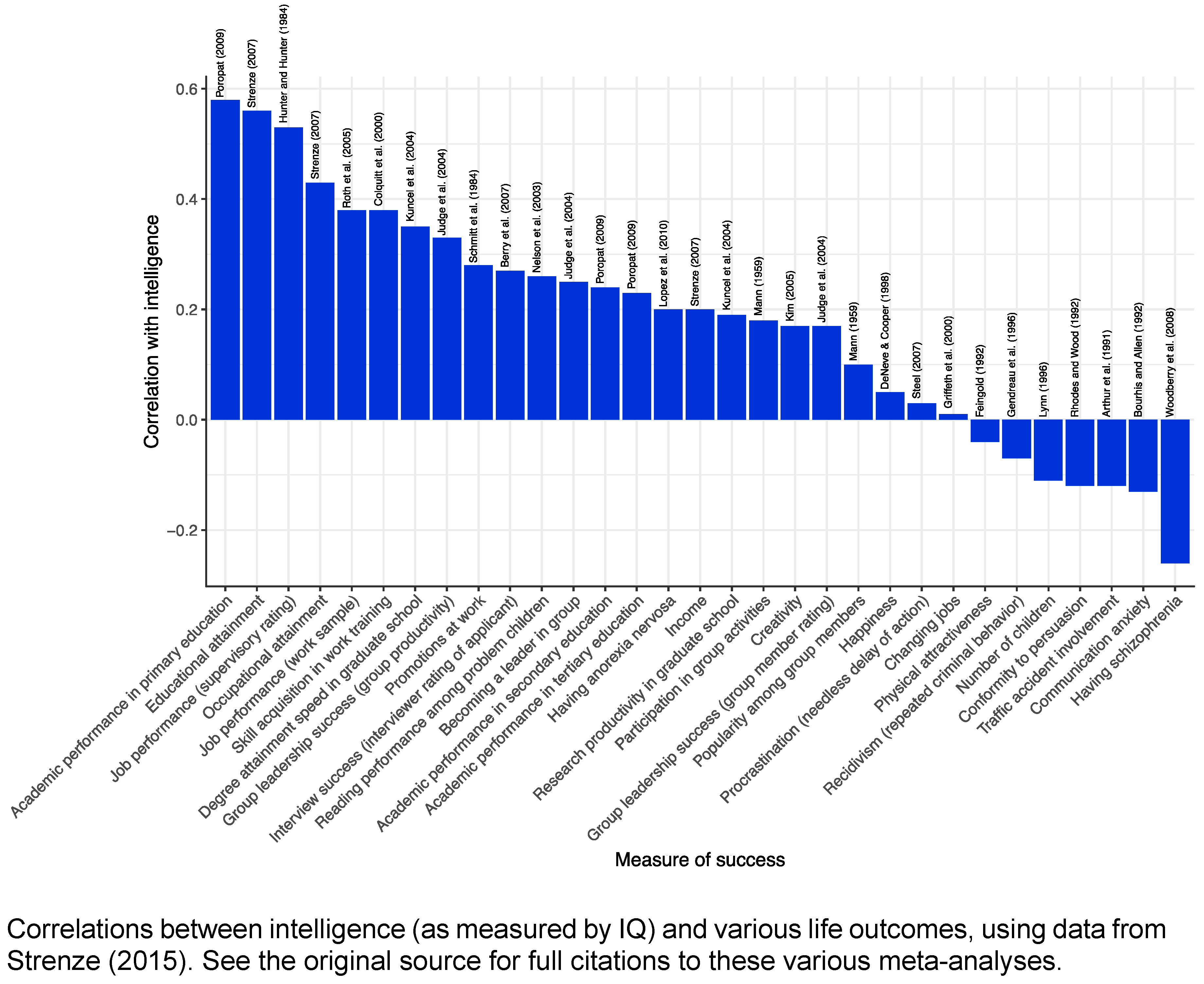
To ensure that it measured the influence of cognitive ability on income, rather than the influence of socio-economic status on IQ, the meta-analysis examining the relation between these variables (Strenze, 2007) used only longitudinal studies, finding that IQ measured early in life predicts income in adulthood. This meta-analysis also found that IQ is a stronger predictor of income than parental socio-economic status or parental education. The fourth edition of the textbook Individual Differences and Personality by Michael C. Ashton (2022, pp. 267–76) discusses two other such correlations: individuals with higher IQ scores tend to be healthier and have longer lives, and also are less likely to commit crimes, even when controlling for socioeconomic status. Consequently, when researchers examine influences on human cognitive ability (as measured by intelligence tests), they are indirectly examining influences on these various other life outcomes as well.
As stated in the previous section, it is widely accepted in differential psychology that intelligence tests do not show cultural bias. This conclusion has been supported in reports published both by the National Academy of Sciences and by the American Psychological Association. The better-known of these two reports, Intelligence: Knowns and Unknowns, was commissioned by the American Psychological Association in response to the controversy surrounding Herrnstein and Murray’s book The Bell Curve in the 1990s. Although the APA report did not support Herrnstein and Murray’s argument that group differences in average test scores include a genetic component, it agreed that “Considered as predictors of future performance, the tests do not seem to be biased against African Americans” (Neisser et al., 1996).10 The earlier report, published in the 1980s by a committee appointed by the National Academy of Sciences, reached a similar conclusion:
The committee further concluded that ability tests predict equally well for all groups of test takers. Research evidence does not support the notion that tests systematically underpredict the performance of minority group members. There are certain important exceptions to this generalization. One cannot give a Spanish-speaking child an English-language test and expect the scores to mean the same as those of a native English speaker. But the research evidence does not support the frequent contention that tests are unfair because they underpredict the performance of certain subpopulations. In this sense, tests are not biased and can be called “fair.”
When differences in average cognitive test scores exist between racial groups, and when the tests also predict life outcomes equally well for all groups, it is inevitable that group differences in average test scores will be reflected in areas of life where the abilities measured by these tests make a difference. A few studies have confirmed this to be the case. A pair of studies by Kevin Beaver et al. (2013a, 2013b) found that the relationship between lower IQ and greater risk of criminal involvement exists across multiple race and gender groups, and that the disparity in arrest and incarceration rates between Black and White American men disappears when controlling for both IQ and self-reported lifetime violence. (However, this does not rule out the existence of other forms of racial discrimination in the American criminal justice system, such as the one described in the preceding section.) Several meta-analyses also have examined group differences in average measures of job performance, finding that these differences are larger in more cognitively demanding tasks (Roth et al., 2001) and that they are about the same size in both subjective and objective measures of job performance (Roth et al., 2003), and replicating both of these results with a third, larger meta-analysis (McKay & McDaniel, 2006).
In a discussion of these various lines of data, Earl B. Hunt’s 2011 textbook Human Intelligence concludes that racial disparities in job performance are “about what would be predicted from the gaps in cognitive test scores and the correlation between test scores and performance.” With respect to studies that examined the relation between test scores and income, Hunt also concludes that the relation between those two variables is “essentially identical” for all of the racial groups examined, meaning that a person with a given test score will, on average, earn approximately the same income regardless of their race (Hunt, 2011, pp. 420–21). This is not a minor source—psychologists regard Hunt’s textbook as one of the most authoritative books published about human intelligence in the early 21st century (Deary, 2012; Johnson, 2016). When a racial disparity is of the size that would be predicted from group differences in average IQ scores, this is sometimes known as “IQ commensurability” (Gordon, 1997).
When it is accurately understood, this body of research undermines both the justification for modern forms of racial discrimination in the name of equity, and older forms of discrimination against disadvantaged groups. Supporters of race research such as Russell Warne (2020, pp. 326–27) and Charles Murray (2021, p. 39) have emphasized that an individual’s abilities cannot be determined from his or her group average, and that therefore all people must be judged based on their individual merits, not based on their racial identities. Warne (2020, p. 316) also discusses the importance of making society as accessible as possible to individuals with low cognitive ability. A similar principle is widely accepted with respect to disadvantages such as blindness or autism, but public ignorance about intelligence research has limited the efforts to assist people whose cognitive ability is below average, when it is not low enough to qualify as an intellectual disability.
These moral principles have not been enough for opponents of race research such as Eric Turkheimer, who argues (2024, pp. 143–44) that contrary to claims about the research not supporting racial prejudice or discrimination, any argument that one group is predisposed to be less intelligent than another is inherently derogatory. However, Turkheimer also accepts that equality in the moral sense is a more fundamental ideal than any hypothesis about the distribution of ability, writing (2024, p. 7) that “For all his imperfection and hypocrisy, Jefferson’s famous sentence meant that people are morally and politically equal despite their obvious differences.” The most important ethical question about race research (as about many other areas of study) is not how it relates to this ideal in isolation, but whether the conclusions of race research are an improvement over what inevitably tends to be concluded in its absence. On the assumption that racial disparities are mostly or entirely due to racist social structures, antiracist scholarship has concluded that all White people who are not actively antiracist are guilty of participating in an unjust social system which benefits them at other groups’ expense. This purported form of racial culpability is known as “white complicity” (Applebaum, 2010; Daum, 2020), and it amounts to a race-based moral judgment of (nearly) all members of a group. Like Kendi’s (2019a) rejection of “the construct of race neutrality”, it also is a conclusion that is difficult to avoid if one accepts its premise about the cause of racial disparities.
There is an ethical imperative to challenge this worldview, because it is the basis for widespread racial discrimination in modern times, undermining one of the central principles of liberal democracies (Forgas, 2025). The assumption that all groups have equal average ability is part of the intellectual foundation of recent discrimination against White Americans by the U.S. public sector, against Jewish and Asian Americans in higher education, and against Black and Hispanic Americans via the practice of race-norming. Arguments that research about group differences is socially harmful, such as those presented in Hastings Center Report and at the AABA symposium, virtually never discuss the recent social consequences of arguments similar to theirs having gained acceptance. When these arguments are made sincerely, and not as a cynical strategy to support racial preferences, they are founded primarily on superficial judgments about what research and ideas often have existed in the company of racial prejudice, rather than on any careful examination of what is or is not actually conducive to a non-discriminatory society.
This point should not be construed as denying the capacity for research about group differences to be misused by individuals on the far right, any more than discussing the value of virology research denies its potential to be misused for biological weapons. In all potentially dangerous areas of study, researchers have a duty to use their knowledge responsibly, and to do what is possible to encourage the same ethical standards in others. In a paper published in Nature, the eminent twentieth-century biologist Bernard Davis explained this situation’s key principle:
Ever since the discovery of fire, and of cutting tools, it has been clear that virtually any scientific knowledge can be used for good or for ill: the costs and benefits depend entirely on how it is used. Moreover, we have only a very limited ability to foresee the eventual scientific benefits of a new discovery: science is a continuous web, and fundamental advances often arise through unexpected cross-fertilisation. For example, there are very good reasons to forbid human cloning: but if we should forbid any research in cell biology that might bring cloning nearer we would seriously impair advances in cancer research.
Davis (1978) is explicit that the principle he is describing applies to the potential “demonstration of heritable differences in the distribution of abilities among different ethnic groups,” but Davis himself did not name specific examples of how such research could be used for beneficial purposes. However, almost fifty years later, Bernard Davis’s conclusion with respect to this area of study is no longer merely theoretical. Instead of trying to prevent research about group differences, out of fear of its well-known capacity to be misused, it would be wiser to ensure that it is used for one particular, essential benevolent purpose. That purpose is to protect the existence of a society in which all individuals have equal rights, one in which no group is punished or disparaged because of its success, and one that recognizes a principle of liberalism described by John F. Kennedy (1963, p. 446): “All of us do not have equal talent, but all of us should have an equal opportunity to develop those talents.”
Funding
This research received no external funding.
Acknowledgments
The author wishes to extend his thanks to Nathan Cofnas. While no one deserves to go through what Cofnas has recently experienced, his current ordeals have the silver lining of demonstrating why this article is needed.
Conflicts of Interest
The author declares no conflict of interest.
References
- Abbot, D.; Bikfalvi, A.; Bleske-Rechek, A. L.; Bodmer, W.; Boghossian, P.; Carvalho, C. M.; Ciccolini, J.; Coyne, J. A.; Gauss, J.; Gill, P. M. W.; Jitomirskaya, S.; Jussim, L.; Krylov, A. I.; Loury, G. C.; Maroja, L.; McWhorter, J. H.; Moosavi, S.; Nayna Schwerdtle, P.; Pearl, J.; West, J. D. In Defense of Merit in Science. Journal of Controversial Ideas 2023, 3(1), 1. [Google Scholar] [CrossRef]
- Akbari, A.; Barton, A. R.; Gazal, S.; Li, Z.; Kariminejad, M.; Perry, A.; Zeng, Y.; Mittnik, A.; Patterson, N.; Mah, M.; Zhou, X.; Price, A.L.; Lander, E.S.; Pinhasi, R.; Rohland, N.; Mallick, S.; Reich, D. Pervasive findings of directional selection realize the promise of ancient DNA to elucidate human adaptation. bioRxiv 2024. [Google Scholar] [CrossRef]
- American Civil Liberties Union. Race and the death penalty. 2003. link to the article.
- American Psychiatric Association. Diagnostic and statistical manual of mental disorders, 5th ed.; American Psychiatric Publishing, 2013. [Google Scholar]
- Anti-Defamation League. Status report: Antisemitism in America after boulder. 11 July 2025. link to the article.
- Applebaum, B. Being white, being good: White complicity, white moral responsibility, and social justice pedagogy; Lexington Books, 2010. [Google Scholar]
- Arambula, J. Catalogue of California’s economic and workforce development programs, services, and initiatives. Assembly committee on jobs, economic development, and the economy. October 2007. link to the article.
- Arcidiacono, P.; Kinsler, J.; Ransom, T. Asian American discrimination in Harvard admissions. European Economic Review 2022, 144, 104079. [Google Scholar] [CrossRef]
- Ashton, M. C. Individual differences and personality, 4th ed.; Academic Press, 2022. [Google Scholar]
- Athreya, S. G.; Cabana, G.; Glantz, M. M. Looking within: Why race scientists easily exploit anthropological science. 93rd Annual Meeting of the American Association of Biological Anthropologists, Los Angeles, CA, USA, March 22; 2024. [Google Scholar]
- Batchelor, T. Fact check: Is Oakland program excluding white families living in poverty from $500 checks? Newsweek. 26 March 2021. link to the article.
- Bawaan, N. Prof under investigation after making comments about race and IQ in class. The Ubyssey. 27 January 2022. link to the article.
- Beaver, K. M.; DeLisi, M.; Wright, J.P.; Boutwell, B. B.; Barnes, J. C.; Vaughn, M. G. No evidence of racial discrimination in criminal justice processing: Results from the national longitudinal study of adolescent health. Personality and Individual Differences 2013a, 55(1), 29–34. [Google Scholar] [CrossRef]
- Beaver, K. M.; Schwartz, J. A.; Nedelec, J. L.; Connolly, E. J.; Boutwell, B. B.; Barnes, J. C. Intelligence is associated with criminal justice processing: Arrest through incarceration. Intelligence 2013b, 41(5), 277–88. [Google Scholar] [CrossRef]
- Berg, J. J.; Harpak, A.; Sinnott-Armstrong, N.; Joergensen, A. M.; Mostafavi, H.; Field, Y.; Boyle, E. A.; Zhang, X.; Racimo, F.; Pritchard, J.K.; Coop, G. Reduced signal for polygenic adaptation of height in UK Biobank. Elife 2019, 8, e39725. [Google Scholar] [CrossRef]
- Bernstein, D. L. Woke antisemitism: How a progressive ideology harms jews; Wicked Son, 2022. [Google Scholar]
- Biden, J. Executive order on advancing racial equity and support for underserved communities through the federal government. The White House. 20 January 2021. link to the article.
- Biden, J. Remarks by president biden on the bipartisan infrastructure law. The White House. 14 January 2022. link to the article.
- Bird, K.; Jackson, J.; Winston, A. A bibliography of racial hereditarian research; Zenodo, 15 August 2023; link to the article.
- Bird, K.; Jackson, J. P., Jr.; Winston, A. S. Confronting scientific racism in psychology: Lessons from evolutionary biology and genetics. American Psychologist 2024, 79(4), 497–508. [Google Scholar] [CrossRef]
- Britschgi, C. Basic income programs in Marin county and Oakland exclude white people. Is that legal? Reason. 29 March 2021. link to the article.
- Butkovich, S. MWBE certification: What it means for your organization and why it matters. Next City. 19 February 2021. link to the article.
- Cabanatuan, M. $1,000-a-month guaranteed income program coming to Marin County. San Francisco Chronicle, 24 March 2021. [Google Scholar]
- California Public Utilities Commission. Supplier clearinghouse certification. 2025. link to the article.
- California State Legislature. The constitutions of California and the united states with related documents, 2019–2020 edition. June 2019. link to the article.
- Candeub, A. The NIH’S genomic data sharing policy and the first amendment. Journal of Free Speech Law 2024, 5, 65–94. [Google Scholar]
- Carl, J. The unprotected class: How anti-white racism is tearing America apart; Regnery, 2024. [Google Scholar]
- Carl, N.; Woodley, M. A. The taboo remains: Responding to a critical commentary. Intelligence 2024, 102, 101806. [Google Scholar] [CrossRef]
- Carter, S.; Asabor, E.; Packard, G.; Kenwood, M.; Jordan, A.; Ross, R. A. A critical awareness approach to cluster hiring for academic inclusion. Journal of the National Medical Association 2025, 117(2), 98–106. [Google Scholar] [CrossRef]
- Casey, T. Trump versus the universities. Political Insight 2025, 16(2), 4–7. [Google Scholar] [CrossRef]
- Ceci, S.; Williams, W. M. Should scientists study race and IQ? YES: The scientific truth must be pursued. Nature 2009, 457, 788–89. [Google Scholar] [CrossRef] [PubMed]
- Chandler, M.; Eberhardt, P.; Wial, H. Racial equity in America’s new industrial transformation. Initiative for a Competitive Inner City. May 2024. link to the article.
- Clark, C. J.; Fjeldmark, M.; Lu, L.; Baumeister, R. F.; Ceci, S.; Frey, K.; Miller, G.; Reilly, W.; Tice, D.; von Hippel, W.; Williams, W. M.; Winegard, B. M.; Tetlock, P. E. Taboos and self-censorship among US psychology professors. Perspectives on Psychological Science 2025, 20(5), 941–57. [Google Scholar] [CrossRef] [PubMed]
- Coffman, S. Words of the founding fathers selected quotations of Franklin, Washington, Adams, Jefferson, Madison and Hamilton, with sources; McFarland & Company, 2012. [Google Scholar]
- Cofnas, N. Judaism as a group evolutionary strategy: A critical analysis of Kevin MacDonald’s theory. Human Nature 2018, 29(2), 134–56. [Google Scholar] [CrossRef] [PubMed]
- Cofnas, N. Is Kevin Macdonald’s theory of Judaism ‘plausible’? A response to Dutton (2019). Evolutionary Psychological Science 2019, 5(1), 143–50. [Google Scholar] [CrossRef]
- Cofnas, N. The anti-Jewish narrative. Philosophia 2021, 49(4), 1329–44. [Google Scholar] [CrossRef]
- Cofnas, N. Still no evidence for a jewish group evolutionary strategy. Evolutionary Psychological Science 2023, 9(2), 236–59. [Google Scholar] [CrossRef]
- Cofnas, N. Posted on X.com. 9 April 2025a. link to the article.
- Cofnas, N. Beating woke with facts and logic. Nathan Cofnas’s Newsletter. 9 October 2025b. link to the article.
- Connor, G.; Fuerst, J. (Eds.) Studying correlations between genetic variation and test score gaps; Cambridge Scholars Publishing, 2024. [Google Scholar]
- Daum, C. W. White complicity. New Political Science 2020, 42(3), 443–49. [Google Scholar] [CrossRef]
- Davis, B. B. The moralistic fallacy. Nature 1978, 272, 390. [Google Scholar] [CrossRef]
- Deary, I. J. Looking down on human intelligence: From psychometrics to the Brain; Oxford University Press, 2000. [Google Scholar]
- Deary, I. J. Intelligence. Annual Review of Psychology 2012, 63, 453–82. [Google Scholar] [CrossRef]
- Deary, I. J.; Cox, S. R.; Hill, W. D. Genetic variation, brain, and intelligence differences. Molecular Psychiatry 2022, 27(1), 335–53. [Google Scholar] [CrossRef]
- Delgado, R.; Stefancic, J. Critical race theory: An introduction, 4th ed.; New York University Press, 2023. [Google Scholar]
- DiAngelo, R. White fragility: Why it’s so hard for white people to talk about racism; Beacon Press, 2018. [Google Scholar]
- Eligon, J. A Covid-19 relief fund was only for black residents. Then came the lawsuits. The New York Times, 3 January 2021. [Google Scholar]
- Elliott, W. E. Y. Levy, L. W., Karst, K. L., Eds.; Fifteenth amendment (judicial interpretation). In Encyclopedia of the American constitution, 2nd ed.; Macmillan Reference, 2000; pp. 1041–42. [Google Scholar]
- Fang, H.; Hui, Q.; Lynch, J.; Honerlaw, J.; Assimes, T. L.; Huang, J.; Vujkovic, M.; Damrauer, S. M.; Pyarajan, S.; Gaziano, J. M.; DuVall, S. L.; O’dOnnell, C. J.; Cho, K.; Chang, K.; Wilson, P. W.; Tsao, P. S.; Ramoni, R.; Breeling, J.; Huang, G.; Tang, H. Harmonizing genetic ancestry and self-identified race/ethnicity in genome-wide association studies. The American Journal of Human Genetics 2019, 105(4), 763–72. [Google Scholar] [CrossRef]
- Farron, S. Prejudice is free, but discrimination has costs. Journal of Libertarian Studies 2000, 14(2), 179–245. [Google Scholar]
- Flynn, J. R. Would you wish the research undone? Nature 2009, 458, 146. [Google Scholar] [CrossRef]
- Flynn, J. R. Are we getting smarter?: Rising IQ in the twenty-first century; Cambridge University Press, 2012. [Google Scholar]
- Flynn, J. R. Academic freedom and race: You ought not to believe what you think may be true. Journal of Criminal Justice 2018, 59, 127–31. [Google Scholar] [CrossRef]
- Flynn, K.; Tandon, N.; Nichols, B.; Thompson, A.; West, S.; Castro, A. The American guaranteed income studies: Oakland, California; Center for Guaranteed Income Research, April 2025; link to the article.
- Ford, P. L. (Ed.) The writings of Thomas Jefferson, Vol. IX: 1807–1815; G. P. Putnam’s Sons, 1898. [Google Scholar]
- Forgas, J. P. Forgas, J. P., Ed.; On false beliefs in academia. In The psychology of false beliefs; Routledge, 2025; pp. 188–211. [Google Scholar]
- Friedersdorf, C. Why California rejected racial preferences, again. The Atlantic, 10 November 2020. [Google Scholar]
- Friedersdorf, C. How to move on from the worst of identity politics. The Atlantic, 15 December 2024. [Google Scholar]
- Galewitz, P. Vermont to give minority residents priority for COVID vaccines. Scientific American. 6 April 2021. link to the article.
- Gerstmann, E. Federal appellate court rules that Biden administration can’t deny COVID relief funds to white restaurant owners. Forbes. 3 June 2021a. link to the article.
- Gerstmann, E. Biden is prioritizing billions of COVID funds by race and gender. Is that constitutional? Forbes. 11 May 2021b. link to the article.
- Goldberg, M. The vibe shifts against the right. The New York Times, 14 April 2025. [Google Scholar]
- Goldfarb, S. How DEI inspires jew hatred. City Journal. 2 November 2023. link to the article.
- Gordon, R. A. Everyday life as an intelligence test: Effects of intelligence and intelligence context. Intelligence 1997, 24(1), 203–320. [Google Scholar] [CrossRef]
- Gottfredson, L. Flores-Mendoza, C. E., Colom, R., Eds.; Social consequences of group differences in cognitive ability. In Introdução à psicologia das diferenças individuais; Artmed Publishers, 2006; pp. 433–56. [Google Scholar]
- Griesbach, W. C. Decision and order granting plaintiffs’ motion for a temporary restraining order; United States District Court, Eastern District of Wisconsin, 2021; link to the article.
- Grunewald, K. F. Atkins v. virginia. Capital Defense Journal 2002, 15(1), 117–26. [Google Scholar]
- Guo, J.; Wu, Y.; Zhu, Z.; Zheng, Z.; Trzaskowski, M.; Zeng, J.; Robinson, M. R.; Visscher, P. M.; Yang, J. Global genetic differentiation of complex traits shaped by natural selection in humans. Nature communications 2018, 9(1), 1865. [Google Scholar] [CrossRef] [PubMed]
- Haier, R. J.; Colom, R.; Hunt, E. The science of human intelligence, 2nd ed.; Cambridge University Press, 2024. [Google Scholar]
- Halstead, R. Marin Community Foundation ends guaranteed income experiment. Marin Independent Journal. 1 July 2024. link to the article.
- Hancock Estabrook. MWBE services legal alert: New York MWBE program extended through July 1, 2028. 30 June 2025. link to the article.
- Harris, K. Remarks by vice president Harris at Oakland generation fund event. The White House. 12 August 2022. link to the article.
- Hartocollis, A. Harvard Rated Asian-American Applicants Lower on Personality Traits, Suit Says. The New York Times, 15 June 2018. [Google Scholar]
- Harvard University. Presidential task force on combating antisemitism and anti-Israeli bias. 29 April 2025. link to the article.
- Horn, D. Why the most educated people in America fall for Anti-Semitic lies. The Atlantic, 15 February 2024. [Google Scholar]
- Howard, T. C.; Navarro, O. Critical race theory 20 years later: Where do we go from here? Urban Education 2016, 51(3), 253–73. [Google Scholar] [CrossRef]
- Hunt, E. Human intelligence; Cambridge University Press, 2011. [Google Scholar]
- Jandarova, N.; Rustichini, A. Selection and the roy model in the neolithic transition. SSRN 2023, 4357095. link to the article. [Google Scholar] [CrossRef]
- Jefferson, T. Notes on the state of Virginia; Lilly and Wait, 1832. First published in 1785. [Google Scholar]
- Johnson, W. Earl ‘Buz’ hunt, 1933–2016. Intelligence 2016, 58, 82–83. [Google Scholar] [CrossRef]
- Kalat, J. Introduction to psychology, 12th ed.; Cengage learning, 2022. [Google Scholar]
- Kane, J. Created kinds and the origin of birds. In God’s word or human reason?: An inside perspective on creationism; Kane, J., Willoughby, E., Keesey, T. M., Morton, G., Comer, J., Eds.; Inkwater Press, 2016; pp. 105–80. [Google Scholar]
- Kendi, I. X. How to be an antiracist; One World, 2019a. [Google Scholar]
- Kendi, I. X. Pass an anti-racist constitutional amendment. Politico. 2019b. link to the article.
- Kennedy, J. F. Public papers of the presidents of the United States: John F. Kennedy, Containing the public messages, speeches, and statements of the president, January 1 to November 22, 1963; United States Government Printing Office, 1963. [Google Scholar]
- Keys, D. P.; Maratea, R. J. (Eds.) Race and the death penalty: The legacy of McCleskey v. Kemp; Lynne Rienner Publishers, 2016. [Google Scholar]
- Knox, L. Education department: DEI violates civil rights law. Inside Higher Ed. 15 February 2025. link to the article.
- Krishnamurthy, P. Harvard’s cult of personality. The Hill. 26 October 2022. link to the article.
- Kuijpers, Y.; Domínguez-Andrés, J.; Bakker, O. B.; Gupta, M. K.; Grasshoff, M.; Xu, C.; Joosten, L. A.; Bertranpetit, J.; Netea, M. G.; Li, Y. Evolutionary trajectories of complex traits in European populations of modern humans. Frontiers in Genetics 2022, 13, 833190. [Google Scholar] [CrossRef] [PubMed]
- Lakatos, I. Schilpp, P. A., Ed.; Popper on demarcation and induction. In The philosophy of sir Karl popper; Open Court Publishing Co., 1974; pp. 139–67. [Google Scholar]
- Lederman, J. Why jews must dismantle Diversity, Equity, and Inclusion (DEI). Jewish Journal, 31 January 2024. [Google Scholar]
- Lee, J. Don’t even go there. City Journal. 19 October 2022. link to the article.
- Mac Donald, H. When race trumps merit; DW Books, 2023. [Google Scholar]
- MacDonald, K. The culture of critique; AuthorHouse, 1998. [Google Scholar]
- Maratea, R. J. Killing with prejudice: Institutionalized racism in American capital punishment; NYU Press, 2019. [Google Scholar]
- Mark, J. Government presumption of racial disadvantage under siege by White plaintiffs. The Washington Post, 18 December 2023. [Google Scholar]
- McKay, P. F.; McDaniel, M. A. A reexamination of black-white mean differences in work performance: More data, more moderators. Journal of Applied Psychology 2006, 91(3), 538–54. [Google Scholar] [CrossRef] [PubMed]
- Meyer, M. N.; Appelbaum, P. S.; Benjamin, D. J.; Callier, S. L.; Comfort, N.; Conley, D.; Freese, J.; Garrison, N. A.; Hammonds, E. M.; Harden, K. P.; Lee, S. S.; Martin, A. R.; Martschenko, D. O.; Neale, B. M.; Palmer, R. H. C.; Tabery, J.; Turkheimer, E.; Turley, P.; Parens, E. Wrestling with social and behavioral Genomics: Risks, potential benefits, and ethical responsibility. Hastings Center Report 2023, 53, S2–S49. [Google Scholar] [CrossRef] [PubMed]
- Michael, G. Professor Kevin Macdonald’s critique of Judaism: Legitimate scholarship or the intellectualization of anti-semitism? Journal of Church and State 2006, 48(4), 779–806. [Google Scholar] [CrossRef]
- Miele, F. Intelligence, race and genetics: Conversations with Arthur R. Jensen; Westview Press, 2002. [Google Scholar]
- Mirtajani, S. B.; Farnia, P.; Hassanzad, M.; Ghanavi, J.; Farnia, P.; Velayati, A. A. Geographical distribution of cystic fibrosis; The past 70 years of data analysis. Biomedical and Biotechnology Research Journal (BBRJ) 2017, 1(2), 105–12. [Google Scholar]
- Murray, C. Facing reality: Two truths about race in America; Encounter Books, 2021. [Google Scholar]
- Nagar, S. D.; Conley, A. B.; Jordan, I. K. Population structure and pharmacogenomic risk stratification in the United States. BMC Biology 2020, 18(140), 140. [Google Scholar] [CrossRef]
- National Archives. Civil rights act (1964). 8 February 2022. link to the article.
- Neisser, U.; Boodoo, G.; Bouchard, T. J.; Wade Boykin, A.; Brody, N.; Ceci, S. J.; Halpern, D. F.; Loehlin, J. C.; Perloff, R.; Sternberg, R. J.; Urbina, S. Intelligence: Knowns and unknowns. American Psychologist 1996, 51(2), 77–101. [Google Scholar] [CrossRef]
- Norris, D. On emergency motion for injunction pending appeal and to expedite appeal; United States District Court for the Eastern District of Tennessee at Knoxville, 2021. link to the article.
- Panofsky, A.; Dasgupta, K.; Iturriaga, N.; Koch, B. Confronting the ‘weaponization’ of genetics by racists online and elsewhere. Hastings Center Report 2024, 54, S14–S21. [Google Scholar] [CrossRef]
- Perry, M. New chart illustrates graphically the racial preferences for blacks, Hispanics being admitted to US medical schools; American Enterprise Institute, 25 June 2017. link to the article.
- Pinker, S. When everyone knows that everyone knows...: Common Knowledge and the mysteries of money, power, and everyday life; Scribner, 2025. [Google Scholar]
- Plomin, R.; Asbury, K. G is for genes: The impact of genetics on education and achievement; Wiley Blackwell, 2014. [Google Scholar]
- Plomin, R.; Von Stumm, S. The new genetics of intelligence. Nature Reviews Genetics 2018, 19(3), 148–59. [Google Scholar] [CrossRef]
- Racimo, F.; Berg, J. J.; Pickrell, J. K. Detecting polygenic adaptation in admixture graphs. Genetics 2018, 208(4), 1565–84. [Google Scholar] [CrossRef]
- Ravani, S. ‘It comforted me’: Oakland’s guaranteed income program ends. Here’s who it helped. San Francisco Chronicle, 22 April 2025. [Google Scholar]
- Relethford, J. H. Race and global patterns of phenotypic variation. American Journal of Physical Anthropology 2009, 139(1), 16–22. [Google Scholar] [CrossRef] [PubMed]
- Reynolds, C. R.; Altmann, R. A.; Allen, D. N. Mastering modern psychological testing: Theory and methods, 2nd ed.; Springer International Publishing, 2021. [Google Scholar]
- Ritchie, S. The NIH’s misguided genetics data policy. Science Fictions. 27 October 2022. link to the article.
- Roseman, C. Do the math or someone will do it to you: Re-strategizing approaches to combating race science. 93rd Annual Meeting of the American Association of Biological Anthropologists, Los Angeles, CA, USA, March 22; 2024a. [Google Scholar]
- Roseman, C. Symposium: Undermining the production of race science. 93rd Annual Meeting of the American Association of Biological Anthropologists, Los Angeles, CA, USA, March 22; 2024b. link to the article. [Google Scholar]
- Rossman-Benjamin, T. Why DEI programs can’t address campus antisemitism. Sapir 2023, 10, 98–105, Summer. [Google Scholar]
- Roth, P. L.; Bevier, C. A.; Bobko, P.; Switzer, F. S.; Tyler, P. Ethnic group differences in cognitive ability in employment and educational settings: A meta-analysis. Personnel Psychology 2001, 54(2), 297–330. [Google Scholar] [CrossRef]
- Roth, P. L.; Huffcutt, A. I.; Bobko, P. Ethnic group differences in measures of job performance: A new meta-analysis. Journal of Applied Psychology 2003, 88(4), 694–706. [Google Scholar] [CrossRef] [PubMed]
- Sailer, J. Diversity statement, then dossier; National Association of Scholars, 16 September 2023. [Google Scholar]
- Sailer, J. How DEI becomes discrimination. The Wall Street Journal, 5 July 2024. [Google Scholar]
- Sailer, J. D. How DEI bureaucrats control university hiring. City Journal. 7 July 2025a. link to the article.
- Sailer, J. D. Cornell’s racialist hiring scheme. City Journal. 30 June 2025b. link to the article.
- Sanger, R. M. IQ, intelligence tests, ‘ethnic adjustments’ and Atkins. American University Law Review 2015, 65(1), 87–150. [Google Scholar]
- Schrider, D. R.; Kern, A. D. Soft sweeps are the dominant mode of adaptation in the human genome. Molecular Biology and Evolution 2017, 34(8), 1863–77. [Google Scholar] [CrossRef] [PubMed]
- Schulson, M. Kevin MacDonald and the elevation of Anti-Semitic pseudoscience. Undark. 27 June 2018. link to the article.
- Shapiro, D. L.; Ferguson, S.; Hernandez, K.; Kennedy, T.; Black, R. Ethnic adjustment abuses in forensic assessment of intellectual abilities. Practice Innovations 2019, 4(4), 265–81. [Google Scholar] [CrossRef]
- Sherman, J. I’ll give you a fact. January 2022. link to the article.
- Sherry, S. DEI and antisemitism: Bred in the bone. FIU Law Review 2025, 19(3), 901–19. [Google Scholar] [CrossRef]
- Shulevitz, J.; Star, A.; Tooby, J. Slate magazine dialogue On: How to deal with fringe academics; University of California Santa Barbara Center for Evolutionary Psychology, 2000; link to the article.
- Sohail, M.; Maier, R. M.; Ganna, A.; Bloemendal, A.; Martin, A. R.; Turchin, M. C.; Chiang, C. W.; Hirschhorn, J.; Daly, M. J.; Patterson, N.; Neale, B.; Mathieson, I.; Reich, D.; Sunyaev, S. R. Polygenic adaptation on height is overestimated due to uncorrected stratification in genome-wide association studies. Elife 2019, 8, e39702. [Google Scholar] [CrossRef]
- Stern, A. J.; Nielsen, R. Balding, D. J., Moltke, I., Marioni, J., Eds.; Detecting natural selection. In Handbook of statistical genomics, 4th ed.; John Wiley & Sons, 2019; pp. 397–420. [Google Scholar]
- Strenze, T. Intelligence and socioeconomic success: A meta-analytic review of longitudinal research. Intelligence 2007, 35(5), 401–26. [Google Scholar] [CrossRef]
- Strenze, T. Goldstein, S., Princiotta, D., Naglieri, J. A., Eds.; Intelligence and success. In Handbook of intelligence: Evolutionary theory, historical perspective, and current concepts; Springer, 2015; pp. 405–13. [Google Scholar]
- Tang, H.; Quertermous, T.; Rodriguez, B.; Kardia, S. L.; Zhu, X.; Brown, A.; Pankow, J. S.; Province, M. A.; Hunt, S. C.; Boerwinkle, E.; Schork, N. J.; Risch, N. J. Genetic structure, self-identified race/ethnicity, and confounding in case-control association studies. The American Journal of Human Genetics 2005, 76(2), 268–75. [Google Scholar] [CrossRef]
- Tezuka, S. Cognitive creationism compared to young-earth creationism. Journal of Controversial Ideas 2021, 1, 3. [Google Scholar] [CrossRef]
- Tezuka, S. Cognitive distortions. Quillette. 18 July 2022. link to the article.
- Thompson, J. Richard Lynn’s contributions to personality and intelligence. Personality and Individual Differences 2012, 53(2), 157–61. [Google Scholar] [CrossRef]
- Tomuschat, C. Protection of human rights under universal international law. UN Chronicle 2017, 53(4), 23–25. [Google Scholar] [CrossRef]
- Trainor, C. Title VI of the civil rights act in light of students for fair admissions v. Harvard; U.S. Department of Education, 14 February 2025. link to the article.
- Tress, L. Chanting ‘700,’ pro-Palestinian activists in New York fete Hamas attack. The Times of Israel, 9 October 2023. [Google Scholar]
- Turkheimer, E. Understanding the nature-nurture debate; Cambridge University Press, 2024. [Google Scholar]
- United Nations General Assembly. Universal declaration of human rights; U.S. Government Printing Office, 1949. [Google Scholar]
- United States Congress. District court ruling on MBDA business development program. 25 March 2024. link to the article.
- United States Supreme Court. Atkins v. Virginia, 536 U.S. 304. 2002. link to the article.
- Warne, R. T. In the know: Debunking 35 myths about human intelligence; Cambridge University Press, 2020. [Google Scholar]
- West, M.; Kraut, R.; Chew, H. E. I’d blush if I could: Closing gender divides in digital skills through education; UNESCO, 2019; link to the article.
- Wigdor, A. K. Ability testing: Uses, consequences, and controversies. Educational Measurement 1982, 1(3), 6–8. [Google Scholar] [CrossRef]
- Winegard, B.; Winegard, B.; Anomaly, J. Dodging Darwin: Race, evolution, and the hereditarian hypothesis. Personality and Individual Differences 2020, 160, 109915. [Google Scholar] [CrossRef]
- Young, E. A.; Blondel, E. C. Ramiro Hernandez, aka Ramiro Hernandez-Llanas, petitioner, v. William T. Stephens, Director, Texas Department of Criminal Justice, Correctional Institutions Division, Respondent: Petition for a writ of certiorari to the united states court of appeals for the fifth circuit. 2014. link to the article.
- Yuan, J.; Hu, Z.; Mahal, B. A.; Zhao, S. D.; Kensler, K. H.; Pi, J.; Hu, X.; Zhang, Y.; Wang, Y.; Jiang, J.; Li, C.; Zhong, X.; Montone, K. T.; Guan, G.; Tanyi, J. L.; Fan, Y.; Xu, X.; Morgan, M. A.; Long, M.; Zhang, L. Integrated analysis of genetic ancestry and genomic alterations across cancers. Cancer Cell 2018, 34(4), 549–60. [Google Scholar] [CrossRef]
| 1 | Subsequent research by Sohail et al. (2019) and Berg et al. (2019) suggests that earlier studies had overestimated the degree of genetic differentiation in height between global populations. This criticism is specifically against past research on differences in polygenic scores for height, not scores for the other traits mentioned here. However, these results also demonstrate the need for diligence in accounting for population stratification (a potential source of false positives in genome-wide association studies). |
| 2 | These papers variously use the terms “intelligence,” “cognitive ability,” “cognitive skills,” and “scores on intelligence tests” for the trait that has been subject to recent positive selection. |
| 3 | James Flynn, one of the most prominent proponents of a purely environmental cause of group differences, has offered a possible explanation for these restrictions: “I tell U.S. academics I can only assume that they believe that racial IQ differences have a genetic component, and fear what they might find” (Flynn, 2012, p. 36). This comment was about the observation that academics regarded research about group differences as less deserving of funding than research on mundane topics, such as whether squirrels enjoy Mozart (he gave that specific example). Flynn (2018) provides more detail, describing an incident in which a major university was unwilling to acknowledge a political motive for their refusal to fund research about the former topic: “They had to argue that the most trivial grant they had approved (something like whether chipmunks like Mozart) was more important than clarifying the causes of racial differences.” These explanations were offered because at the time, it was not yet common for academics to openly argue that research about group differences should be forbidden. |
| 4 | Retrospective coverage by authors such as Kalen Flynn et al. (2025) has described these experiments as a success, due to the stimulus programs having improved their beneficiaries’ quality of life. This coverage has not discussed whether the racially discriminatory aspect of the programs was legal or ethical. |
| 5 | |
| 6 | California’s voters upheld their state’s constitutional prohibition against racial preferences in November 2020, and the Marin Country and Oakland programs were implemented in March 2021. However, the legal definition of “public employment, public education, or public contracting” may not extend to monetary stimulus programs. The constitutional status of California’s MBE program, which has established what effectively amounts to a set of racial quotas in public contracting, is more dubious. |
| 7 | The claim that Jewish disproportionate success is a form of racial injustice, requiring corrective measures, has a dark history. In Germany during the early years of the Nazi era, this was among the main arguments used to justify antisemitic policies such as the 1935 Nuremberg laws: see Farron (2000) for an overview. |
| 8 | MacDonald’s book is cited here only as a summary of his views, not to make any claim as to its factual accuracy. |
| 9 | History bears out this conclusion. Farron (2000) describes several historical cases in which governments’ programs of racial preferences failed to produce the desired racial ratios in income, business profits and/or employment. Farron attributes this outcome primarily to the fact that regardless of a government’s racial policies, individuals tend to have economic incentives to act in a way that is race-neutral and meritocratic. |
| 10 | Intelligence: Knowns and Unknowns mentions a slight trend in the opposite direction, with African Americans having slightly lower scholastic performance than would be predicted from intelligence test scores alone. However, sources published in the 2020s that discuss the tests’ lack of bias, such as those cited in the previous section by Warne, Reynolds et al. and Kalat, do not mention such a trend. |
© 2026 Copyright by the author. This article is an open access article distributed under the terms and conditions of the Creative Commons Attribution (CC BY) license (https://creativecommons.org/licenses/by/4.0/).
